Background Frailty is a clinical syndrome that increases the vulnerability to adverse outcomes in older adults. C-X-C motif ligand 9 (CXCL9), a marker of chronic inflammation, has been implicated in musculoskeletal decline and mortality. However, its relationship with frailty in older individuals has not been well studied.
Methods This study included 237 community-dwelling women, aged 65 years or older, who underwent a comprehensive geriatric assessment. Serum CXCL9 levels were measured by enzyme-linked immunosorbent assay. Frailty was defined using the Fried phenotype and the Rockwood deficit accumulation index. Associations between serum CXCL9 levels and frailty outcomes were examined using a multivariate regression analysis.
Results Serum CXCL9 increased progressively across the frailty categories (robust: 239.3±110.1 pg/mL; frail: 347.5±119.0 pg/mL; P<0.001). Higher levels of CXCL9 were independently associated with a greater frailty index (β=0.0001, P<0.001), lower skeletal muscle index (β=−0.001, P=0.004), weaker grip strength (β=−0.010, P<0.001), and slower gait speed (β=−0.0003, P=0.039). Women in the highest CXCL9 quartile had 3.20-fold greater odds of frailty (95% confidence interval [CI], 1.70 to 14.56), 3.41-fold greater odds of sarcopenia (95% CI, 1.25 to 9.30), and 6.71-fold greater odds of low muscle strength (95% CI, 1.75 to 25.78) compared with the lowest quartile.
Conclusion Elevated CXCL9 levels were independently associated with greater frailty burden and adverse musculoskeletal phenotypes in older women. These findings support CXCL9 as a promising biomarker of chronic inflammation and frailty, and warrant further investigation through longitudinal studies.
Diabetes, obesity and metabolism Big Data Articles (National Health Insurance Service Database)
Background This study investigated the independent and joint impacts of the geriatric nutritional risk index (GNRI) and frailty index (FI) on all-cause and cause-specific mortality in patients with diabetes.
Methods This study included 1,790 National Health and Nutrition Examination Survey participants between 1999 and 2018. GNRI and FI were used to assess patients with diabetes, who were categorized into low GNRI and high GNRI groups, as well as low FI and high FI groups, to evaluate older adults’ nutritional status. These groups were combined into four categories. Weighted Cox proportional hazards models, Kaplan-Meier survival curves, and restricted cubic spline regression models were applied to assess the independent and joint associations of GNRI and FI with all-cause and cause-specific mortality in patients with diabetes.
Results The median follow-up period was 100 months, during which 720 deaths occurred. An independent linear dose-response relationship between GNRI, FI, and all-cause mortality risk was observed. The combination of low GNRI and high FI was significantly associated with increased risk of all-cause mortality (hazard ratio, 1.65; 95% confidence interval [CI], 1.02 to 2.68) for the low GNRI+low FI group, 2.03 (95% CI, 1.61 to 2.55) for the high GNRI+high FI group, and 3.65 (95% CI, 2.38 to 5.58) for the low GNRI+high FI group. Stratified analysis (reference: high GNRI+low FI group) showed an increased mortality risk among men in the low GNRI+high FI group.
Conclusion The combination of low GNRI and high FI was independently and jointly associated with increased risk of all-cause, cardiovascular disease, diabetes, and hypertension mortality, particularly among men.
Mineral, bone & muscle Big Data Articles (National Health Insurance Service Database)
Background Despite the critical role of vitamin D in various biological processes, its impact on frailty—a condition closely linked to biological age—remains inconclusive. This study aimed to explore the association between serum 25-hydroxyvitamin D (25[OH] D) levels and frailty status in older Korean adults, utilizing a comprehensive frailty index (FI) and a nationally representative dataset.
Methods This cross-sectional study included 6,589 participants aged ≥65 years from the Korea National Health and Nutrition Examination Survey (2008–2012). Frailty was assessed using a deficit accumulation FI based on 38 physical, cognitive, psychological, and social items.
Results After adjusting for potential confounders, frail men showed 6.8% lower serum 25(OH)D concentrations compared to nonfrail controls (P=0.007). Men in the lowest serum 25(OH)D quartile (≤39.3 nmol/L) exhibited a 5.3% higher FI (P=0.047) and 1.71-fold increased odds of frailty (P=0.005), compared to those in the highest quartile (>63.3 nmol/L). Similarly, men with vitamin D deficiency (<30 nmol/L) exhibited a 9.6% higher FI compared to those with sufficient vitamin D levels (≥50 nmol/L; P=0.004). However, no significant association between serum 25(OH)D concentration and frailty was observed in women across any analysis.
Conclusion These findings suggest that low serum 25(OH)D concentrations are a potential risk factor for frailty, particularly in men. Further research is warranted to determine whether vitamin D supplementation in such high-risk older adults could help mitigate frailty.
Citations
Citations to this article as recorded by
Oxidative stress in frailty among older adults: are malondialdehyde and superoxide dismutase the key biomarkers? Yuyang Zhang, Jiali Zheng, Xiaoxiao Zhang, Yanwen Zhang, Kexin Zhang, Yujiao Hao, Yang Li, Tingting Ma, Xinyu Bai, Yulu Wang, Yaogang Wang, Qi Lu, Yue Zhao Biogerontology.2026;[Epub] CrossRef
Background This study investigated the risk of frailty in older adults with differentiated thyroid cancer (DTC) and the effect of thyroid- stimulating hormone (TSH) levels on frailty.
Methods This single-center, cross-sectional study included 70 DTC patients aged ≥60 years with stable TSH levels during the previous year while receiving levothyroxine. Frailty was assessed using the fried frailty phenotype (FFP). Anterior thigh muscle thickness was measured by ultrasound, and the sonographic thigh adjustment ratio (STAR) index was calculated. Muscle strength was measured using a hand dynamometer. Physical activity was determined by the physical activity scale for the elderly (PASE).
Results The median (interquartile range) age and follow-up time were 65 years (62 to 71) and 11 years (7.0 to 14.2), respectively. The median TSH level was 1.10 μIU/mL (0.49 to 1.62), and 58.6% of patients were prefrail/frail. Muscle mass and strength were reduced in 35.7% and 17.2% of patients, respectively. TSH levels were lower in those with prefrailty/frailty (P=0.002), low muscle mass (P=0.014), and low strength (P=0.037) than in their normal counterparts. TSH levels correlated negatively with FFP (P= 0.001) and positively with the STAR index (P=0.034). TSH below 1.325 μIU/mL was associated with an increased frailty risk (area under the curve=0.719; P=0.001). Low TSH, female sex, low handgrip strength, and low PASE leisure time scores emerged as independent predictors of frailty (P<0.05).
Conclusion Older adults with lower TSH levels due to DTC are at high frailty risk and have low muscle mass and strength. Therefore, TSH targets should be set based on a comprehensive evaluation with consideration of the risk-benefit ratio.
Background Sclerostin, initially recognized for its pivotal role in bone metabolism, has gained attention for its multifaceted impact on overall human health. However, its influence on frailty—a condition that best reflects biological age—has not been thoroughly investigated.
Methods We collected blood samples from 244 older adults who underwent comprehensive geriatric assessments. Sclerostin levels were quantified using an enzyme-linked immunosorbent assay. Frailty was assessed using two validated approaches: the phenotypic model by Fried and the deficit accumulation frailty index (FI) by Rockwood.
Results After controlling for sex, age, and body mass index, we found that serum sclerostin levels were significantly elevated in frail individuals compared to their robust counterparts (P<0.001). There was a positive correlation between serum sclerostin concentrations and the FI (P<0.001). Each standard deviation increase in serum sclerostin was associated with an odds ratio of 1.87 for frailty (P=0.003). Moreover, participants in the highest quartile of sclerostin levels had a significantly higher FI and a 9.91-fold increased odds of frailty compared to those in the lowest quartile (P=0.003 and P=0.039, respectively).
Conclusion These findings, which for the first time explore the association between circulating sclerostin levels and frailty, have significant clinical implications, positioning sclerostin as one of potential blood-based biomarkers for frailty that captures the comprehensive physical, mental, and social aspects of the elderly, extending beyond its traditional role in bone metabolism.
Citations
Citations to this article as recorded by
Irisin, Sclerostin, and Inflammatory Axis: Implication in Bone‐Muscle Wasting Diseases Mohamad Maged, Sameh Heikal, Salma Ibrahim, Sameh E. Hassanein Cell Biochemistry and Function.2026;[Epub] CrossRef
The bone-cerebrovascular axis: effects of bone aging on neurovascular dysfunction and neurodegeneration Jiekang Wang, Xu Cao, Mei Wan Journal of Clinical Investigation.2026;[Epub] CrossRef
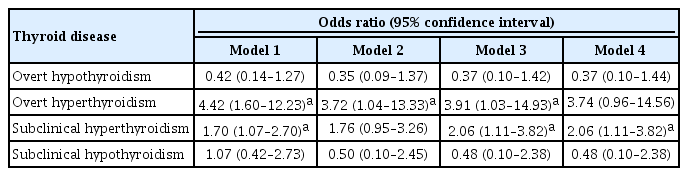
Background This study investigates the association between thyroid function and frailty in the old patients using representative data.
Methods The study was conducted using data from the Korea National Health and Nutrition Examination Survey conducted from 2013 to 2015. The study population included 2,416 participants aged 50 years and older with available thyroid function test data. Frailty assessment was performed using the Fried frailty phenotype. The prevalence of frailty was analyzed across different thyroid diseases and thyroid function parameters.
Results The significant association between thyroid dysfunction and frailty was observed in overt hyperthyroidism and subclinical hyperthyroidism. After adjusting for various factors, the association between thyroid dysfunction and frailty remained significant. On the other hand, overt hypothyroidism did not show a significant association with frailty in the adjusted analysis. For individuals with overt hyperthyroidism and subclinical hyperthyroidism, higher levels of free thyroxine (FT4) were significantly associated with an increased risk of frailty (aOR >999; 95% CI, >999 to 999). Among individuals with overt hypothyroidism, lower level of FT4 levels and high thyrotropin (TSH) levels showed a significant association with frailty risk (FT4: aOR, <0.01; TSH: aOR, 999). In participants with subclinical hypothyroidism, there were no significant associations between parameters for thyroid and frailty risk.
Conclusion These findings suggest that thyroid dysfunction, particularly overt hyperthyroidism and subclinical hyperthyroidism, may be associated with an increased risk of frailty in the old patients.
Citations
Citations to this article as recorded by
Association Between the Modified Frailty Index and Short‐Term Total Thyroidectomy Complications Tyler Jung, Eman Ahmad, Oluwatobiloba Ayo‐Ajibola, Matthew E. Lin, Lauran K. Evans, Carlos X. Castellanos, Josef Madrigal, Ian Kim, Dinesh K. Chhetri, Peter S. Han The Laryngoscope.2026;[Epub] CrossRef
Association of iodized salt intake with the risk of physical frailty in patients with type 2 diabetes Jiang Li, Jie Li, Ying Sun, Yanqi Fu, Wenqi Shen, Lingli Cai, Fei Xu, Ling Gao, Ningjian Wang, Bin Wang, Yingli Lu The Journal of nutrition, health and aging.2025; 29(6): 100543. CrossRef
Development and validation of a predictive nomogram for frailty based on thyroid function in older adults Xiaotian Shi, Huayu Yang, Shan Wang, Yifan Yang, Yuanyuan Li, Guoze Dou, Qing Ma European Geriatric Medicine.2025; 16(5): 1861. CrossRef
Associations between thyroid function, thyroid hormone sensitivity indices, and frailty: Insights from a large cross-sectional study Yusheng Zhang, Daowen Zhang, Chenwen Yuan, Yiming Wang, Hao Zhu, Yu Duan Experimental Gerontology.2025; 208: 112822. CrossRef
Subclinical hyperthyroidism Alasdair Cooper, Prakash Abraham Current Opinion in Endocrinology, Diabetes & Obesity.2025; 32(5): 175. CrossRef
Endocrine Adaptations to Prolonged Fasting: From Physiology, Clinical Uncertainties, Translational Challenges to Healthspan Implications Rok Herman, Jure Trsan, Luka Lipar, Mojca Jensterle, Andrej Janez Nutrients.2025; 17(24): 3949. CrossRef
Associations of thyroid feedback quantile-based index with diabetes in euthyroid adults in the United States and China Heng Wan, Genfeng Yu, Yajun He, Siyang Liu, Xingying Chen, Yuqi Jiang, Hualin Duan, Xu Lin, Lan Liu, Jie Shen Annals of Medicine.2024;[Epub] CrossRef
Comorbid Hypothyroidism and Low-Alanine Aminotransferase-Associated Sarcopenia Associated with Shortened Survival: A Retrospective Study of 16,827 Patients over a 21-Year Period Omer Segal, Rabia Khoury, Adva Vaisman, Gad Segal Journal of Clinical Medicine.2024; 13(19): 5838. CrossRef
A Neglected Point: Frailty in Older Adults with Differentiated Thyroid Cancer Meric Coskun, Esra Cataltepe, Hacer Dogan Varan, Eda Ceker, Yasemin Bektas, Yasemin Kuscu, Mehmet Muhittin Yalcin, Mujde Akturk, Fusun Balos Toruner, Mehmet Ayhan Karakoc, Alev Eroglu Altinova Endocrinology and Metabolism.2024; 39(6): 899. CrossRef