
 KES

Search
- Page Path
- HOME > Search
Original Articles
- Mineral, bone & muscle
- Higher Circulating Kynurenine Levels Linked to Higher Risk of Sarcopenia in Older Adults: A Cohort Study and UK Biobank Analysis
- June Yeon Kim, Yunju Jo, So Jeong Park, Ji Yeon Baek, Geonyoung Jang, Eunju Lee, Hyuk Sakong, Su Jung Kim, Sung-Jin Kim, Dongryeol Ryu, Hyun Ju Yoo, Beom-Jun Kim
- Endocrinol Metab. 2026;41(3):428-441. Published online December 12, 2025
- DOI: https://doi.org/10.3803/EnM.2025.2586

- 4,319 View
- 96 Download
- 1 Web of Science
- 1 Crossref
-
 Abstract
 PDF
 Supplementary Material
 PubReader
 ePub
- Background
While experimental studies show kynurenine, a tryptophan metabolite, drives muscle catabolism through pro-oxidative and inflammatory mechanisms, clinical evidence linking circulating kynurenine to sarcopenia in humans remains scarce.
Methods
In a cross-sectional study of 165 community-dwelling older adults, sarcopenia was diagnosed using Asian-specific criteria and serum kynurenine levels were measured by liquid chromatography-tandem mass spectrometry. Using UK Biobank datasets, plasma indoleamine 2,3-dioxygenase 1 (IDO1)—the enzyme converting tryptophan to kynurenine—was quantified via Olink proteomics, and Mendelian randomization was used to assess the causal effect of plasma IDO1 on sarcopenia risk based on genomewide association study data.
Results
In multivariable adjusted analyses, older adults with sarcopenia, low muscle mass, or weak muscle strength had 21.3%–29.2% higher serum kynurenine concentrations than controls (P<0.001 to 0.010). Circulating kynurenine levels were inversely correlated with skeletal muscle index and grip strength (P=0.001 and 0.022, respectively). Each standard deviation increase in serum kynurenine was associated with a 1.80–2.97-fold increased risk for sarcopenia-related outcomes (P<0.001 to 0.010). In the UK Biobank, higher IDO1 activity was associated with reduced muscle mass and strength (P=0.007 and P=0.004, respectively), and Mendelian randomization indicated a significant causal relationship between plasma IDO1 levels and increased sarcopenia risk (P= 0.010, β=0.105).
Conclusion
These findings extend previous experimental evidence to the clinical setting, suggesting that elevated kynurenine—driven by IDO1 activity—contributes to sarcopenia in older adults. Circulating kynurenine may serve as an exploratory biomarker candidate for identifying individuals at heightened risk for muscle deterioration, warranting further validation in future studies. -
Citations
Citations to this article as recorded by
- Biomarkers and Early Mechanisms of Sarcopenia: Central Roles of Mitochondrial Dysfunction, Inflammaging, Cellular Senescence, and Neuromuscular Degeneration
Hechmi Toumi, Ahmad Almhdie-Imjabbar, Nada Ibrahim, Eric Lespessailles
International Journal of Molecular Sciences.2026; 27(14): 6332. CrossRef
- Biomarkers and Early Mechanisms of Sarcopenia: Central Roles of Mitochondrial Dysfunction, Inflammaging, Cellular Senescence, and Neuromuscular Degeneration

- Diabetes, Obesity and Metabolism
- Tetrahydrocurcumin Ameliorates Kidney Injury and High Systolic Blood Pressure in High-Fat Diet-Induced Type 2 Diabetic Mice
- Weerapon Sangartit, Kyung Bong Ha, Eun Soo Lee, Hong Min Kim, Upa Kukongviriyapan, Eun Young Lee, Choon Hee Chung
- Endocrinol Metab. 2021;36(4):810-822. Published online August 27, 2021
- DOI: https://doi.org/10.3803/EnM.2021.988
- 9,897 View
- 203 Download
- 15 Web of Science
- 16 Crossref
-
Abstract
PDFPubReader ePub
- Background
Activation of the intrarenal renin-angiotensin system (RAS) is implicated in the pathogenesis of kidney injury and hypertension. We aimed to investigate the protective effect of tetrahydrocurcumin (THU) on intrarenal RAS expression, kidney injury, and systolic blood pressure (SBP) in high-fat diet (HFD)-induced type 2 diabetic mice.
Methods
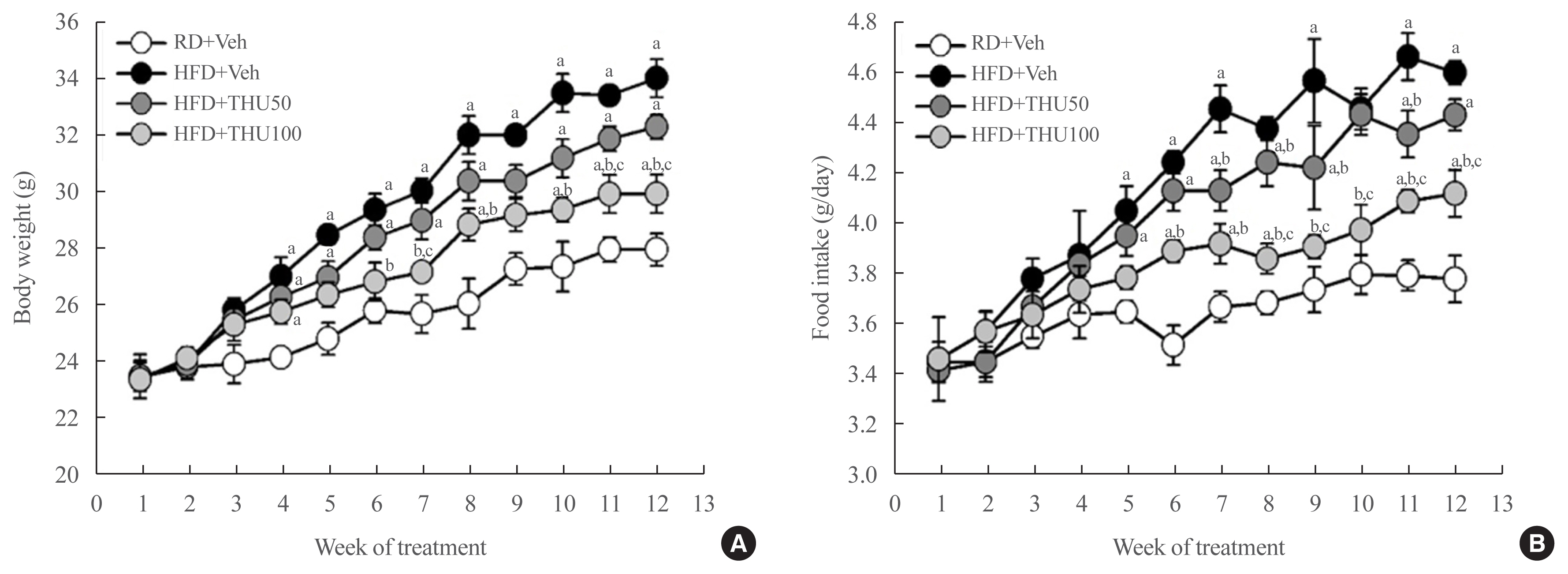
Eight-week-old male mice were fed a regular diet (RD) or HFD for 12 weeks, and THU (50 or 100 mg/kg/day) was intragastrically administered with HFD. Physiological and metabolic changes were monitored and the expression of RAS components and markers of kidney injury were assessed.
Results
HFD-fed mice exhibited hyperglycemia, insulin resistance, and dyslipidemia compared to those in the RD group (P<0.05). Kidney injury in these mice was indicated by an increase in the ratio of albumin to creatinine, glomerular hypertrophy, and the effacement of podocyte foot processes. Expression of intrarenal angiotensin-converting enzyme, angiotensin II type I receptor, nicotinamide adenine dinucleotide phosphate (NADPH) oxidase-4, and monocyte chemoattractant protein-1 was also markedly increased in HFD-fed mice. HFD-fed mice exhibited elevated SBP that was accompanied by an increase in the wall thickness and vascular cross-sectional area (P<0.05), 12 weeks post-HFD consumption. Treatment with THU (100 mg/kg/day) suppressed intrarenal RAS activation, improved insulin sensitivity, and reduced SBP, thus, attenuating kidney injury in these mice.
Conclusion
THU alleviated kidney injury in mice with HFD-induced type 2 diabetes, possibly by blunting the activation of the intrarenal RAS/nicotinamide adenine dinucleotide phosphate oxidase IV (NOX4)/monocyte chemoattractant protein 1 (MCP-1) axis and by lowering the high SBP. -
Citations
Citations to this article as recorded by- Synthetic curcumin analogs in nephrotoxicity: Mechanisms and therapeutic advances
Farzaneh Hayati, Sahar Ghoflchi, Asie Sadeghi, Prashant Kesharwani, Amirhossein Sahebkar, Hossein Hosseini
Food and Chemical Toxicology.2026; 209: 115921. CrossRef - NOX4-mediated oxidative stress in diabetic complications: Potential of natural products
Sachin Sharma, Ashwani Mittal, Manjusha Choudhary
Pharmacological Research - Natural Products.2026; 10: 100515. CrossRef - Potential Protective Effects of Curcumin on Aspirin-Induced Toxicity Kidney in Rats
Batrisyia Balqis Mohd Asri, Elysha Nur Ismail, Reezal Ishak
Malaysian Journal of Medicine and Health Sciences.2026; : 1. CrossRef - Pharmacological regulation of mitochondrial fitness and intercellular transfer mechanisms in mesenchymal stem cells for diabetic kidney disease therapy
Wen Zhang, Huiling Xie, Min Bai, Zhihao Sun, Shengchao Ma, Jing Xiao, Meng Jin, Yan Zhang, Xiangdong Zhu, Jianfeng Wang, Takeshi Taketani, Yue Liu, Jiahao Yang
Journal of Pharmaceutical Analysis.2026; : 101814. CrossRef - Tetrahydrocurcumin alleviates di-(2-ethylhexyl) phthalate-induced adipose tissue dysfunction and testicular toxicity in adult mice: possible involvement of adiponectin-adipoR signaling in the testis
Choirul Anwar, Yu-Chi Chu, Mei-Ling Tsai, Chi-Tang Ho, Ching-Shu Lai
Food & Function.2025; 16(2): 583. CrossRef - Repurposing Nano Curcumin: Unveiling its Therapeutic Potential in Diabetic Nephropathy
Rarchita Sharma, Yogesh Mali, Yogeeta. O. Agrawal, Vinit V. Agnihotri, Sameer N. Goyal
Current Drug Targets.2025; 26(5): 298. CrossRef - Research Progress on the Antioxidant Activity of Natural Diarylheptanoids: Mechanisms and Structure–activity Relationships
An-Na Ma, Tie Yao, Ya-Jing Guo, Chong-Yan Zhao, Bing-jie Wang, Gen Li, Feng Qiu
Current Medicinal Chemistry.2025; 32(13): 2494. CrossRef - Research and advances in mouse models of diabetic nephropathy: a narrative review
Kang Xie, Yan Ma, Jingjing Din, Yujie Jin, Siwen Zhang, Shiqiang Liu, Cui Yu, Xu Wu, Chunyan Xing, Lizhuo Wang, Jialin Gao
BMC Nephrology.2025;[Epub] CrossRef - Topical Application of miR-200b-3p by Poloxamer 407-Based Hydrogel Accelerates Diabetic Wound Healing
Wan-Yu Lo, Cian-Huei Sin, Huang-Joe Wang
Diabetes, Metabolic Syndrome and Obesity.2025; Volume 18: 3845. CrossRef - Combination of THU/ALK-5i exhibits profound anti-MASH activity through suppression of lipogenesis and fibrogenesis
Kampeebhorn Boonloh, Eun Soo Lee, Su Ho Jo, Na Won Park, So Bin Lee, Choon Hee Chung
Scientific Reports.2025;[Epub] CrossRef - The role of tetrahydrocurcumin in disease prevention and treatment
Mengting Zhou, Rui Li, Hua Hua, Ying Dai, Zhujun Yin, Li Li, Jin Zeng, Mengni Yang, Junning Zhao, Ruirong Tan
Food & Function.2024; 15(13): 6798. CrossRef - The Development of Dyslipidemia in Chronic Kidney Disease and Associated Cardiovascular Damage, and the Protective Effects of Curcuminoids
Zeltzin Alejandra Ceja-Galicia, Ana Karina Aranda-Rivera, Isabel Amador-Martínez, Omar Emiliano Aparicio-Trejo, Edilia Tapia, Joyce Trujillo, Victoria Ramírez, José Pedraza-Chaverri
Foods.2023; 12(5): 921. CrossRef - Translation Animal Models of Diabetic Kidney Disease: Biochemical and Histological Phenotypes, Advantages and Limitations
Wenting Luo, Shiyun Tang, Xiang Xiao, Simin Luo, Zixuan Yang, Wei Huang, Songqi Tang
Diabetes, Metabolic Syndrome and Obesity.2023; Volume 16: 1297. CrossRef - Curcumin ameliorates focal segmental glomerulosclerosis by inhibiting apoptosis and oxidative stress in podocytes
Hui Zhang, Qing-Qing Dong, Hua-Pan Shu, Yu-Chi Tu, Qian-Qian Liao, Li-Jun Yao
Archives of Biochemistry and Biophysics.2023; 746: 109728. CrossRef - An examination of the protective effects and molecular mechanisms of curcumin, a polyphenol curcuminoid in diabetic nephropathy
Xiaoyu Zhu, Xingli Xu, Chigang Du, Yanping Su, Lixue Yin, Xiaoqiu Tan, Hui Liu, Yiru Wang, Lei Xu, Xinghua Xu
Biomedicine & Pharmacotherapy.2022; 153: 113438. CrossRef - An integrated bioinformatics analysis and experimental study identified key biomarkers CD300A or CXCL1, pathways and immune infiltration in diabetic nephropathy mice
WEI LIANG, QIANG LUO, ZONGWEI ZHANG, KEJU YANG, ANKANG YANG, QINGJIA CHI, HUAN HU
BIOCELL.2022; 46(8): 1989. CrossRef
- Synthetic curcumin analogs in nephrotoxicity: Mechanisms and therapeutic advances
- Clinical Study
- Diagnostic Role of Captopril Challenge Test in Korean Subjects with High Aldosterone-to-Renin Ratios
- Jung Hee Kim, Kyeong Seon Park, A Ram Hong, Chan Soo Shin, Seong Yeon Kim, Sang Wan Kim
- Endocrinol Metab. 2016;31(2):277-283. Published online May 13, 2016
- DOI: https://doi.org/10.3803/EnM.2016.31.2.277
- 15,995 View
- 63 Download
- 18 Web of Science
- 17 Crossref
-
Abstract
PDFPubReader
Background Diagnosis of primary aldosteronism (PA) begins with aldosterone-to-renin ratio (ARR) measurement followed by confirmative tests. However, the ARR has high false positive rates which led to unnecessary confirmatory tests. Captopril challenge test (CCT) has been used as one of confirmatory tests, but the accuracy of it in the diagnosis of PA is still controversial. We aimed to examine the clinical efficacy of CCT as a post-screening test in PA.
Methods In a prospective study, we enrolled subjects with suspected PA who had hypertension and ARR >20 (ng/dL)/(ng/mL/hr). Sixty-four patients who underwent both the saline infusion test and the CCT were included.
Results The diagnostic performance of plasma aldosterone concentration (PAC) post-CCT was greater than that of ARR post-CCT and ARR pre-CCT in PA (area under the curve=0.956, 0.797, and 0.748, respectively;
P =0.001). A cut-off value of 13 ng/dL showed the highest diagnostic odds ratio considering PAC post-CCT at 60 and 90 minutes. A PAC post-CCT of 19 ng/dL had a specificity of 100%, which can be used as a cut-off value for the confirmative test. Determining the diagnostic performance of PAC post-CCT at 90 minutes was sufficient for PA diagnosis. Subjects with PAC post-CCT at 90 minutes <13 ng/dL are less likely to have PA, and those with PAC post-CCT at 90 minutes ≥13 but <19 ng/dL should undergo secondary confirmatory tests.Conclusion The CCT test may be a reliable post-screening test to avoid the hospitalization in the setting of falsely elevated ARR screening tests.
-
Citations
Citations to this article as recorded by- The diagnostic utility of the captopril challenge test for primary aldosteronism in a Bangladeshi population: a prospective study
Sharmin Jahan, Zhong X. Lu, Muhammad Akram, M.A. Hasanat, M. Fariduddin, Peter J. Fuller, Jun Yang
Pathology.2025; 57(7): 917. CrossRef - Comparison of different criteria of captopril challenge test for the diagnosis of primary aldosteronism
Qiang Fu, Shili Peng, Yixin Zhang, Ying Song, Jinbo Hu, Qifu Li, Yifan He, Shumin Yang, Yue Wang, Qifu Li, Ying Song, Shumin Yang, Wenwen He, Mei Mei, Jinbo Hu, Suxin Luo, Kangla Liao, Yao Zhang, Yunfeng He, Yihong He, Ming Xiao, Bin Peng
Endocrine.2025; 90(2): 952. CrossRef - Captopril's influence on Danio rerio embryonic development: Unveiling significant toxic outcomes at environmentally relevant concentrations
Fernando García-Valdespino, Gustavo Axel Elizalde-Velázquez, Selene Elizabeth Herrera-Vázquez, Leobardo Manuel Gómez-Oliván
Science of The Total Environment.2024; 933: 173179. CrossRef - Comparison of four confirmatory tests for the diagnosis of primary aldosteronism: Bayesian analysis in the absence of a gold standard
Hang Shen, Wenjin Luo, Jinbo Hu, Jun Yang, Ying Song, Xiangjun Chen, Yi Yang, Linqiang Ma, Qingfeng Cheng, Zhihong Wang, Qifu Li, Shumin Yang, Qifu Li, Ying Song, Shumin Yang, Wenwen He, Mei Mei, Jinbo Hu, Suxin Luo, Kangla Liao, Yao Zhang, Yunfeng He, Yi
Endocrine.2024; 85(3): 1417. CrossRef - Exclusion Tests in Unilateral Primary Aldosteronism (ExcluPA) Study
Rui Zhu, Tungalagtamir Shagjaa, Giacomo Rossitto, Brasilina Caroccia, Teresa Maria Seccia, Dario Gregori, Gian Paolo Rossi
The Journal of Clinical Endocrinology & Metabolism.2023; 108(2): 496. CrossRef - Captopril challenge test in the diagnosis of primary aldosteronism: consistency between 1- and 2- h sampling
Xinyu Liu, Chao Guo, Jin Bian, Sufang Hao, Ying Lou, Huimin Zhang, Xianliang Zhou, Jun Cai, Wenjun Ma
Frontiers in Endocrinology.2023;[Epub] CrossRef - Performance of Confirmatory Tests for Diagnosing Primary Aldosteronism: a Systematic Review and Meta-Analysis
Alexander A. Leung, Christopher J. Symonds, Gregory L. Hundemer, Paul E. Ronksley, Diane L. Lorenzetti, Janice L. Pasieka, Adrian Harvey, Gregory A. Kline
Hypertension.2022; 79(8): 1835. CrossRef - Baseline Plasma Aldosterone Level and Renin Activity Allowing Omission of Confirmatory Testing in Primary Aldosteronism
Junji Kawashima, Eiichi Araki, Mitsuhide Naruse, Isao Kurihara, Katsutoshi Takahashi, Kouichi Tamura, Hiroki Kobayashi, Shintaro Okamura, Shozo Miyauchi, Koichi Yamamoto, Shoichiro Izawa, Tomoko Suzuki, Akiyo Tanabe
The Journal of Clinical Endocrinology & Metabolism.2020; 105(5): e1990. CrossRef - The number of positive confirmatory tests is associated with the clinical presentation and incidence of cardiovascular and cerebrovascular events in primary aldosteronism
Aya Saiki, Daisuke Tamada, Reiko Hayashi, Kosuke Mukai, Tetsuhiro Kitamura, Mitsuyoshi Takahara, Michio Otsuki, Iichiro Shimomura
Hypertension Research.2019; 42(8): 1186. CrossRef - The characteristics of captopril challenge test–positive patients using various criteria
Satoshi Kidoguchi, Naoki Sugano, Naomi Hayashi-Ishikawa, Norihiko Morisawa, Goro Tokudome, Takashi Yokoo
Journal of the Renin-Angiotensin-Aldosterone System.2019;[Epub] CrossRef - Confirmatory tests for the diagnosis of primary aldosteronism: A systematic review and meta‐analysis
Sicen Wu, Jun Yang, Jinbo Hu, Ying Song, Wenwen He, Shumin Yang, Rong Luo, Qifu Li
Clinical Endocrinology.2019; 90(5): 641. CrossRef - The captopril challenge test for diagnosing primary Aldosteronism in a Chinese population
Ke-ying Zhu, Yan Zhang, Wen-jing Zhang, Hong-yun Li, Wen-huan Feng, Da-long Zhu, Ping Li
BMC Endocrine Disorders.2019;[Epub] CrossRef - Confirmatory Tests for the Diagnosis of Primary Aldosteronism
Ying Song, Shumin Yang, Wenwen He, Jinbo Hu, Qingfeng Cheng, Yue Wang, Ting Luo, Linqiang Ma, Qianna Zhen, Suhua Zhang, Mei Mei, Zhihong Wang, Hua Qing, Dennis Bruemmer, Bin Peng, Qifu Li
Hypertension.2018; 71(1): 118. CrossRef - Evaluation of the Saline Infusion Test and the Captopril Challenge Test in Chinese Patients With Primary Aldosteronism
Xiao Meng, Yanyan Li, Xiaohao Wang, Jianwei Li, Yuping Liu, Yerong Yu
The Journal of Clinical Endocrinology & Metabolism.2018; 103(3): 853. CrossRef - Articles inEndocrinology and Metabolismin 2016
Won-Young Lee
Endocrinology and Metabolism.2017; 32(1): 62. CrossRef - Optimal follow-up strategies for adrenal incidentalomas: reappraisal of the 2016 ESE-ENSAT guidelines in real clinical practice
A Ram Hong, Jung Hee Kim, Kyeong Seon Park, Kyong Young Kim, Ji Hyun Lee, Sung Hye Kong, Seo Young Lee, Chan Soo Shin, Sang Wan Kim, Seong Yeon Kim
European Journal of Endocrinology.2017; 177(6): 475. CrossRef - Agkihpin, a novel SVTLE from Gloydius halys Pallas, promotes platelet aggregation in vitro and inhibits thrombus formation in vivo in murine models of thrombosis
Huiqiong Xie, Miao Huang, Qiping Hu, Kejian Sun, Huayu Wu, Wei Shu, Xiaolong Li, Ling Fang
Toxicon.2016; 122: 78. CrossRef
- The diagnostic utility of the captopril challenge test for primary aldosteronism in a Bangladeshi population: a prospective study
Case Reports
- A Case of Persistent Hyperkalemia After Unilateral Adrenalectomy for Aldosterone-Producing Adenoma.
- Min Jae Yang, Seung Jin Han, Min Seok Lee, Eun Kyung Kim, Hae Jin Kim, Dae Jung Kim, Yoon Sok Chung, Tae Hee Lee, Jang Hee Kim, Kwan Woo Lee
- J Korean Endocr Soc. 2009;24(3):201-205. Published online September 1, 2009
- DOI: https://doi.org/10.3803/jkes.2009.24.3.201
- 3,791 View
- 35 Download
-
Abstract
PDF
- Primary aldosteronism is a syndrome characterized by various clinical features that are due to excessive autonomous aldosterone secretion not sustained by the activation of the renin-angiotensin system. Aldosterone-producing adrenal adenoma is found in approximately 35% of the patients who suffer with primary aldosteronism. Laparoscopic adrenalectomy is the standard treatment for aldosterone-producing adrenal adenoma, and the result of this operation is normalization of the serum potassium and plasma aldosterone concentrations, as well as correcting the plasma renin activity in most cases. However, it is known that some of the patients with aldosterone-producing adrenal adenoma show transient hyperkalemia postoperatively due to the reversible suppression of the renin-aldosterone axis. We recently experienced the case of a 54-year-old woman with an aldosterone-producing adrenal adenoma, and she presented with severe hyperkalemia after unilateral adrenalectomy. Compared with the previously reported cases that showed transient suppression of the rennin-aldosterone axis for less than 7 months, our patient revealed a prolonged episode of hyperkalemia for 8 months postoperatively, and this required continuous mineralocorticoid replacement.
- A Case of Primary Reninism Manifested by Hypertension with Hypokalemia.
- Hyung Jin Choi, Eui Sil Hong, Young Min Cho, Do Joon Park, Chan Soo Shin, Kyong Soo Park, Seong Yeon Kim, Bo Youn Cho, Hong Kyu Lee
- J Korean Endocr Soc. 2005;20(2):168-173. Published online April 1, 2005
- DOI: https://doi.org/10.3803/jkes.2005.20.2.168
- 4,568 View
- 37 Download
- 1 Crossref
-
Abstract
PDF
- Primary reninism is a rare cause of hypertension manifesting along with hypokalemia. A high level of plasma renin activity and a high level of serum aldosterone are the whole markers of primary reninism. Upon making the diagnosis of primary reninism, other more common causes of aldosteronism must be differentiated, such as renovascular hypertension and primary aldosteronism. Primary reninism is commonly caused by juxtaglomerular cell tumor, which is one of the curable causes of hypertension, and this can be successfully treated by conservative surgery. We report here on a case of primary reninism that was caused by juxtaglomerular cell tumor that developed in a 22-year-old female patient. She was recently diagnosed with hypertension and hypokalemia. She had markedly elevated plasma renin activity and an increased serum aldosterone concentration. Computed tomography revealed a mass located in the right kidney and selective renal vein sampling suggested that the mass was secreting an excess of renin. Right nephrectomy was done and her hypertension with hypokalemia was successfully treated. We report here a case of primary reninism that presented with juxtaglomerular cell tumor along with a review of the literature
-
Citations
Citations to this article as recorded by- Reninoma: a rare cause of curable hypertension
Ji Hye Kim, Ji Hyun Kim, Myung Hyun Cho, Eujin Park, Hye Sun Hyun, Yo Han Ahn, Hee Gyung Kang, Kyung Chul Moon, Il-Soo Ha, Hae Il Cheong
Korean Journal of Pediatrics.2019; 62(4): 144. CrossRef
- Reninoma: a rare cause of curable hypertension
- Primary Hyperaldosteronism with Increased Plasma Renin Activity due to Secondary Hypertensive Renal Impairment.
- Kang Woo Lee, Hyuk Sang Kwon, Dong Il Shin, Chee Ho Noh, Jung Min Lee, Jong Min Lee, Kun Ho Yoon, Bong Yun Cha, Kwang Woo Lee, Ho Young Son, Sung Koo Kang
- J Korean Endocr Soc. 2003;18(4):433-438. Published online August 1, 2003
- 1,889 View
- 19 Download
-
Abstract
PDF
- An increased plasma aldosterone concentration, with suppressed plasma renin activity (PRA), is an abnormal finding in primary hyperaldosteronism. A suppressed PRA is caused by aldosterone- dependent sodium retention and extracellular volume expansion. A case of primary hyperaldosteronism, due to adenoma, with increased PRA, was observed. An adrenalectomy and intraoperative renal biopsy was performed. In our patient, histologically proven renal arteriosclerosis was the probable cause of the escape of the PRA from the suppression by an aldosterone-producing adenoma. Normal blood pressure was not attained after the adrenalectomy. However, the blood pressure was then controlled by small doses of antihypertensive drug before resection of the tumor. In this case, the patient was treated with spironolactone, but the blood pressure was not correctly controlled. After the adrenalectomy, the blood pressure was well controlled with smaller dose of calcium channel blockers. So, an early adrenalectomy may be beneficial as soon as the diagnosis of an aldosterone-producing adenoma is confirmed, even in patients with hypertensive nephrosclerosis.
- A Case of Adrenalectomy after Preterm Delivery in Cushing's Syndrome of Third Trimester Pregnant Woman.
- Kwang Sik Song, Jae Kyung Hwang, Ki Tak Ju, Hang Jin Lee, Suk Ho Song, Ki Young Lee, Chan Jong Suh, Hong Kyu Kim, Hyu Young Park, Dal Mo Yang, Young Ha Oh, Moon Ho Kang
- J Korean Endocr Soc. 2001;16(1):134-139. Published online February 1, 2001
- 1,942 View
- 17 Download
-
Abstract
PDF
- A renin- or angiotensin-II responsive aldosterone producing tumor is a rare cause of primary hyperaldosteronism. This tumor can be identified by tests that show that the aldosterone producing adrenal tumor is not fully autonomous. In other words partially it is responsible for the stimulation of aldosterone secretion that results aldosterone levels in an increase in serum in response to the upright posture and spironolactone treatment. Furthermore, the urinary 18-hydroxycortisol level is within the normal range. Because of different responses to surgical removal, the differential diagnosis of the causes of primary aldosteronism can't be overemphasized even for rare causes of primary aldosteronism such as unilateral nodular hyperplasia or a renin-responsible aldosterone producing tumor. We should consider renin or angiotensin-II responsive adrenal adenoma in the differential diagnosis of primary aldosteronism when biochemical data shows atypical results. Here we present the first case in Korea of a renin-responsive aldosterone producing adrenal adenoma which was fully accessible and was successfully treated by surgical removal. Also, sampling for aldosterone secretion just above the insertion site in the left renal vein before surgery showed a suspiciously abberant left adrenal vein drainage into the IVC, This was very helpful information during adrenal vein ligation in laparoscopic adrenalectomy.
- Renin-responsive Adrenal Adenoma with a Suspicious Abberant Adrenal Vein.
- Ji Hyeon Ju, Woo Lee Jung, Jung Min Lee, Kun Ho Yoon, Bong Yun Cha, Ho Young Son, Dong Gu Kim, Eung Kook Kim, Byung Ki Choi
- J Korean Endocr Soc. 2001;16(1):123-129. Published online February 1, 2001
- 3,156 View
- 28 Download
-
Abstract
PDF
- A renin- or angiotensin-II responsive aldosterone producing tumor is a rare cause of primary hyperaldosteronism. This tumor can be identified by tests that show that the aldosterone producing adrenal tumor is not fully autonomous. In other words partially it is responsible for the stimulation of aldosterone secretion that results aldosterone levels in an increase in serum in response to the upright posture and spironolactone treatment. Furthermore, the urinary 18-hydroxycortisol level is within the normal range. Because of different responses to surgical removal, the differential diagnosis of the causes of primary aldosteronism can't be overemphasized even for rare causes of primary aldosteronism such as unilateral nodular hyperplasia or a renin-responsible aldosterone producing tumor. We should consider renin or angiotensin-II responsive adrenal adenoma in the differential diagnosis of primary aldosteronism when biochemical data shows atypical results. Here we present the first case in Korea of a renin-responsive aldosterone producing adrenal adenoma which was fully accessible and was successfully treated by surgical removal. Also, sampling for aldosterone secretion just above the insertion site in the left renal vein before surgery showed a suspiciously abberant left adrenal vein drainage into the IVC, This was very helpful information during adrenal vein ligation in laparoscopic adrenalectomy.
Original Article
- Renin Release by Adenosine Agosists and Antagonists in Two-Kidney One Clip Goldblatt Hypertensive Rats.
- Young Jin Choi, Sun Hee Kim, Kyoung Woo Cho, Jong Huh, Kyung Hwan Seol
- J Korean Endocr Soc. 1998;13(1):67-76. Published online January 1, 2001
- 1,800 View
- 17 Download
-
Abstract
PDF
- BACKGROUND
In two-kidney one clip Goldbaltt hypertensive rats(2K1C GHR), clipped kidney may be exposed to low pressure and unclipped kidney to high pressure. In addition, both kidneys may have a different amount of adenosine which is increased by ischemia and plays an important role for renin release. The aim of this study was to invstigate the responsmiveness for renin release to adenosine agonists and antagonist in clipped and unclipped kidney of 2K1C GHR. METHODS: Emplying kidney slices from both unclipped and unclipped kidney of 2K1C GHR, the alteration by adenosine agonists and antagonist of renin release was studied. RESULTS: The renal renin content and basal renin release from unclipped kidney slices were suppressed, whereas those from clipped kidney were augmented Adenosine Al receptor agonist, cyclohexyladenosne(CHA), phenylisopropyl adenosine(PIA) and adenosine caused a decrease in renin release from clipped kidney slices. Adenosine A2 receptor agonist, NECA, and nonspecific adenosine receptor aganist, 2-chloroadenosine(CA) caused an increase in renin release from clipped kidney slices. Adenosine receptor antagonist, 8-phenyltheophylline(8-PT) caused an increase in renin release from clipped kidney slices. In unclipped kidney, however, the renin release in response to NECA, CA or 8-PT was reversed and the decreasing effect of renin release to CHA and adenosine was slightly inereased. CONCLUSION: These results suggest that the responsiveness of adenosine receptors, which may participate in renin release is modified in clipped and unclipped kidney of 2K1C GHR.
 First
 Prev




