
 KES

Search
- Page Path
- HOME > Search
Review Article
- Mineral, Bone & Muscle
- Long-Term Efficacy and Safety of Denosumab: Insights beyond 10 Years of Use
- Jeonghoon Ha, Youn-Ju Lee, Jinyoung Kim, Chaiho Jeong, Yejee Lim, Jeongmin Lee, Ki-Hyun Baek, on Behalf of the Catholic Medical Center Bone Research Group
- Endocrinol Metab. 2025;40(1):47-56. Published online January 13, 2025
- DOI: https://doi.org/10.3803/EnM.2024.2125

- 63,823 View
- 1,426 Download
- 16 Web of Science
- 18 Crossref
-
 Abstract
 PDF
 PubReader
 ePub
- Osteoporosis management in post-menopausal women focuses on fracture prevention, with denosumab as a key therapeutic option. Despite its proven efficacy in reducing fracture risk and increasing bone mineral density (BMD) over 10 years, its long-term impact remains uncertain. We evaluated the literature on its efficacy and safety beyond the initial decade. Clinical trials and real-world studies confirm denosumab’s sustained efficacy, especially in lumbar spine BMD, with hip BMD stabilizing. Concerns about adverse events (AEs) like hypocalcemia and osteonecrosis of the jaw necessitate vigilant monitoring. Risks of atypical femoral fractures and malignancies also require attention, despite unclear links to treatment duration. Clinical guidelines for denosumab beyond 10 years are limited, emphasizing the need for careful monitoring. In certain scenarios, such as advanced chronic kidney disease, prolonged denosumab may be required to balance AE risks with fracture prevention benefits. Denosumab shows potential for long-term efficacy in augmenting BMD; however, monitoring for AEs is crucial to guide clinical decision-making effectively.
-
Citations
Citations to this article as recorded by
- Enhancing osteoporosis treatment: emerging roles of engineered exosomes in bone regeneration and repair
Hongtao Li, Hongyu Pan, Minshan Feng
Journal of Translational Medicine.2026;[Epub] CrossRef - Denosumab Therapy Beyond 10 Years: Subsequent Treatment and Densitometric Outcomes
Xi Xiong, Chun Ho Wong, Kimberly H. Tsoi, Connie H.N. Loong, Carol H.Y. Fong, Alan C.H. Lee, Chi Ho Lee, Kathryn C.B. Tan, Yu Cho Woo, Manju Chandran, David T.W. Lui
Endocrine Practice.2026; 32(6): 861. CrossRef - Managing Bone Fragility in Older Adults with Diabetes: Pathophysiology, Assessment, and Therapeutic Considerations
Gulistan Bahat, Tugba Erdogan, Savas Ozturk, Ozlem Soyluk Selcukbiricik, Serdar Ozkok, Dilek Gogas Yavuz, Mehmet Akif Karan, Jean-Yves Reginster
Drugs & Aging.2026; 43(4): 341. CrossRef - Comment on “Bone fragility and atypical femoral fractures in SLE: role of disease activity, infection, and treatment”
Manish Juneja, Harshawardhan Ramteke, Rakhshanda Khan
Journal of Bone and Mineral Metabolism.2026; 44(5): 706. CrossRef - Synergistic Efficacy of Calcitriol Combined with Denosumab versus Calcitriol Alone in Postmenopausal Osteoporosis: A Retrospective Cohort Study
Xueyuan Li, Ming Hu, Yi Shen
International Journal of Women's Health.2026; Volume 18: 1. CrossRef - Diagnosis and treatment of osteoporosis: 2026 recommendations of the Polish Society for Rheumatology
Piotr Leszczyński, Cezary Iwaszkiewicz, Zbigniew Michał Żuber, Brygida Kwiatkowska, Bogdan Piotr Batko, Katarzyna Krystyna Pawlak-Buś
Rheumatology.2026;[Epub] CrossRef - Challenges in Sequential Antiresorptive Therapy After Long-Term Denosumab Discontinuation: A Case Report and Narrative Review of the Literature
Maria-Evangelia Koloutsou, Melina Despina Pieper, Maria Mateniadou, Angeliki Papapanagiotou, Athanasios D. Anastasilakis, Polyzois Makras, Maria P. Yavropoulou
Journal of Clinical Medicine.2026; 15(14): 5443. CrossRef - Three-year longitudinal assessment of denosumab’s efficacy and safety in postmenopausal osteoporosis: a 36-month real-world cohort study
Rong-Lin Xia, Chen Li, Li Wang, Ai-Jun Chao, Wei Wei
Frontiers in Medicine.2026;[Epub] CrossRef - Clinical implications of denosumab discontinuation for spine surgeons
Charu Jain, Matthew T. Drake, David Essig, Sohrab Virk, Paul A. Anderson
The Spine Journal.2026; 26(11): 2077. CrossRef - Chronic kidney disease: from mineral dysregulation to bone and cardiovascular disease
Melpomeni Moustaki, Stavroula A. Paschou, Eleni Palioura, Evanthia Kassi, Symeon Tournis, Andromachi Vryonidou
Journal of Endocrinological Investigation.2026; 49(11): 3279. CrossRef - Primary hyperparathyroidism presenting as atraumatic bilateral hip fractures: a case report
Kevin McCarroll, Aisling Carroll, Finlay Brennan, Daire Gargan, Donal Fitzpatrick, Rosaleen Lannon
Journal of Medical Case Reports.2026;[Epub] CrossRef - Management of Osteoporosis and Low Bone Mass in Kidney Disease
Matthew Mulroy, Angela Primbas, Isidro B. Salusky, Jane Weinreb, Albert Shieh
Clinical Journal of the American Society of Nephrology.2026;[Epub] CrossRef - Pharmaceutical market for bone resorption inhibitors in Uzbekistan: structure, trends, and pricing aspects
Z. K. Yusupova, D. T. Saipova
FARMAKOEKONOMIKA. Modern Pharmacoeconomics and Pharmacoepidemiology.2026; 19(3): 475. CrossRef - Sustained increases in lumbar spine and hip BMD with denosumab therapy beyond 10 years
Finlay Brennan, Donal Fitzpatrick, Rosaleen Lannon, Kevin McCarroll
Osteoporosis International.2026;[Epub] CrossRef - Good flatmates: immature neutrophils protect bone integrity
Matthias Gunzer
Blood.2025; 146(11): 1259. CrossRef - Rheumatoid Arthritis and Osteoporosis as Prototypes of Immunosenescence in Osteoimmunology: Molecular Pathways of Inflammaging and Targeted Therapies
Ernesto Aitella, Gianluca Azzellino, Ciro Romano, Lia Ginaldi, Massimo De Martinis
International Journal of Molecular Sciences.2025; 26(19): 9268. CrossRef - Significant Response to Denosumab Yet with Severe Rebound Hypercalcemia in a 9-Year-Old Boy with Aneurysmal Bone Cyst: A Case Report
Laurence Allain, Sarah Elbaz, Sayanthen Sathyakumar, William Le Gallou, Christina Coleman, Hallie Coltin, Dardye Eugène, Abha Gupta, Sebastiano A. G. Lava, Samuele Renzi
Children.2025; 12(11): 1524. CrossRef - Biosimilar denosumab CT-P41 in the treatment of osteoporosis
Karel Urbánek
Clinical Osteology.2025; 30(2): 96. CrossRef
- Enhancing osteoporosis treatment: emerging roles of engineered exosomes in bone regeneration and repair

Original Articles
- Mineral, Bone & Muscle
- Persistence with Denosumab in Male Osteoporosis Patients: A Real-World, Non-Interventional Multicenter Study
- Chaiho Jeong, Jeongmin Lee, Jinyoung Kim, Jeonghoon Ha, Kwanhoon Jo, Yejee Lim, Mee Kyoung Kim, Hyuk-Sang Kwon, Tae-Seo Sohn, Ki-Ho Song, Moo Il Kang, Ki-Hyun Baek
- Endocrinol Metab. 2023;38(2):260-268. Published online April 27, 2023
- DOI: https://doi.org/10.3803/EnM.2023.1663
- 9,140 View
- 166 Download
- 3 Web of Science
- 4 Crossref
-
Abstract
PDF
 Supplementary MaterialPubReader ePub
- Background
Persistence with denosumab in male patients has not been adequately investigated, although poor denosumab persistence is associated with a significant risk of rebound vertebral fractures.
Methods
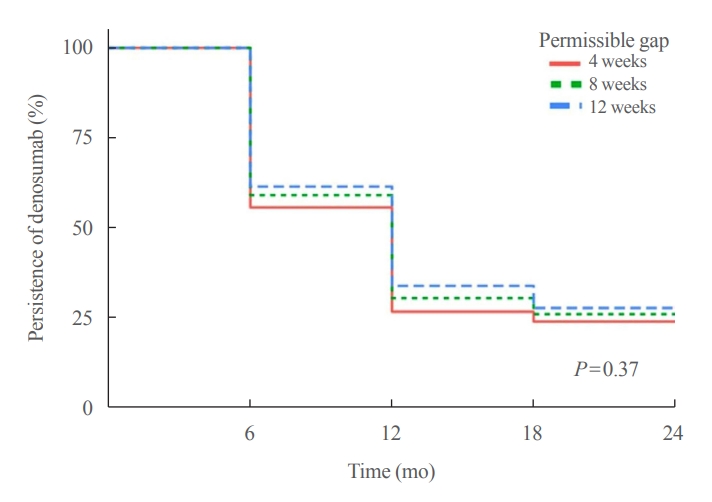
We retrospectively evaluated 294 Korean male osteoporosis patients treated with denosumab at three medical centers and examined their persistence with four doses of denosumab injection over 24 months of treatment. Persistence was defined as the extent to which a patient adhered to denosumab treatment in terms of the prescribed interval and dose, with a permissible gap of 8 weeks. For patients who missed their scheduled treatment appointment(s) during the follow-up period (i.e., no-shows), Cox proportional regression analysis was conducted to explore the factors associated with poor adherence. Several factors were considered, such as age, prior anti-osteoporotic drug use, the treatment provider’s medical specialty, the proximity to the medical center, and financial burdens of treatment.
Results
Out of 294 male patients, 77 (26.2%) completed all four sequential rounds of the denosumab treatment. Out of 217 patients who did not complete the denosumab treatment, 138 (63.6%) missed the scheduled treatment(s). Missing treatment was significantly associated with age (odds ratio [OR], 1.03), prior bisphosphonate use (OR, 0.76), and prescription by non-endocrinologists (OR, 2.24). Denosumab was stopped in 44 (20.3%) patients due to medical errors, in 24 (11.1%) patients due to a T-score improvement over –2.5, and in five (2.3%) patients due to expected dental procedures.
Conclusion
Our study showed that only one-fourth of Korean male osteoporosis patients were fully adherent to 24 months of denosumab treatment. -
Citations
Citations to this article as recorded by- Follow-on osteoporosis therapy after denosumab discontinuation among Medicare beneficiaries
Selvam R. Sendhil, Suzanne M. Cadarette, Sulbh Aggarwal, Arman Oganisian, Andrew R. Zullo, Sarah D. Berry, Michael A. Adegboye, Kaleen N. Hayes
Osteoporosis International.2026; 37(1): 81. CrossRef - Denosumab safety in men with osteoporosis: a disproportionality analysis of the FAERS database
Hou-hong Li, Li Wan, Si-jie He, Wen-long Xie
Naunyn-Schmiedeberg's Archives of Pharmacology.2026; 399(11): 16915. CrossRef - Denosumab—efficacy, safety, persistence and sequential strategies—a systematic review
Natasha Amran Laursen, Anne Sophie Sølling, Torben Harsløf, Bente L. Langdahl
Osteoporosis International.2026;[Epub] CrossRef - Denosumab
Reactions Weekly.2023; 1963(1): 206. CrossRef
- Follow-on osteoporosis therapy after denosumab discontinuation among Medicare beneficiaries
- Diabetes, Obesity and Metabolism
- Effect of the Concomitant Use of Subcutaneous Basal Insulin and Intravenous Insulin Infusion in the Treatment of Severe Hyperglycemic Patients
- Yejee Lim, Jung Hun Ohn, Joo Jeong, Jiwon Ryu, Sun-wook Kim, Jae Ho Cho, Hee-Sun Park, Hye Won Kim, Jongchan Lee, Eun Sun Kim, Nak-Hyun Kim, You Hwan Jo, Hak Chul Jang
- Endocrinol Metab. 2022;37(3):444-454. Published online June 3, 2022
- DOI: https://doi.org/10.3803/EnM.2021.1341
- 68,030 View
- 384 Download
- 15 Web of Science
- 12 Crossref
-
Abstract
PDFSupplementary MaterialPubReader ePub
- Background
No consensus exists regarding the early use of subcutaneous (SC) basal insulin facilitating the transition from continuous intravenous insulin infusion (CIII) to multiple SC insulin injections in patients with severe hyperglycemia other than diabetic ketoacidosis. This study evaluated the effect of early co-administration of SC basal insulin with CIII on glucose control in patients with severe hyperglycemia.
Methods
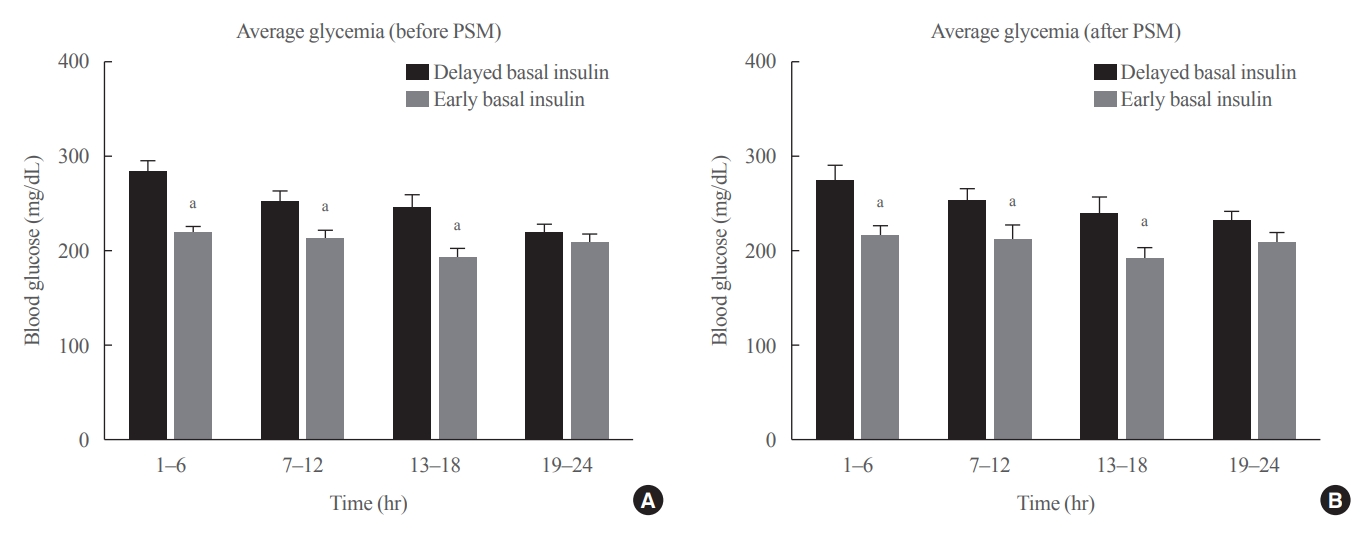
Patients who received CIII for the management of severe hyperglycemia were divided into two groups: the early basal insulin group (n=86) if they received the first SC basal insulin 0.25 U/kg body weight within 24 hours of CIII initiation and ≥4 hours before discontinuation, and the delayed basal insulin group (n=79) if they were not classified as the early basal insulin group. Rebound hyperglycemia was defined as blood glucose level of >250 mg/dL in 24 hours following CIII discontinuation. Propensity score matching (PSM) methods were additionally employed for adjusting the confounding factors (n=108).
Results
The rebound hyperglycemia incidence was significantly lower in the early basal insulin group than in the delayed basal insulin group (54.7% vs. 86.1%), despite using PSM methods (51.9%, 85.2%). The length of hospital stay was shorter in the early basal insulin group than in the delayed basal insulin group (8.5 days vs. 9.6 days, P=0.027). The hypoglycemia incidence did not differ between the groups.
Conclusion
Early co-administration of basal insulin with CIII prevents rebound hyperglycemia and shorten hospital stay without increasing the hypoglycemic events in patients with severe hyperglycemia. -
Citations
Citations to this article as recorded by- Early subcutaneous basal insulin with intravenous insulin infusion for diabetic ketoacidosis management: A systematic review and meta‐analysis of randomised controlled trials
Kitti Thammakosol, Patteera Vongtangton, Pawin Numthavaj, Arunrat Auttara‐atthakorn, Chutintorn Sriphrapradang
Diabetes, Obesity and Metabolism.2026; 28(2): 1036. CrossRef - 16. Diabetes Care in the Hospital: Standards of Care in Diabetes—2026
Mandeep Bajaj, Rozalina G. McCoy, Kirthikaa Balapattabi, Raveendhara R. Bannuru, Natalie J. Bellini, Allison K. Bennett, Elizabeth A. Beverly, Kathaleen Briggs Early, Sathyavathi ChallaSivaKanaka, Andjela Drincic, Justin B. Echouffo-Tcheugui, Brendan M. E
Diabetes Care.2026; 49(Supplement): S339. CrossRef - RSSDI clinical practice guidelines for the management of hyperglycemia in hospitalized patients (2025)
Manoj Chawla, Vijay Viswanathan, Sanjay Agarwal, Anuj Maheshwari, Rakesh Sahay, Pratap Jethwani, Sujoy Ghosh, Sunil Gupta, Nishant Kanodia, A. G. Unnikrishnan, Abhay Kumar Sahoo, Vijaya Kumar, Purvi Chawla, Aravinda Jagadeesha
International Journal of Diabetes in Developing Countries.2026; 46(3): 559. CrossRef - 16. Diabetes Care in the Hospital: Standards of Care in Diabetes—2025
Nuha A. ElSayed, Rozalina G. McCoy, Grazia Aleppo, Kirthikaa Balapattabi, Elizabeth A. Beverly, Kathaleen Briggs Early, Dennis Bruemmer, Justin B. Echouffo-Tcheugui, Laya Ekhlaspour, Rodolfo J. Galindo, Rajesh Garg, Kamlesh Khunti, Rayhan Lal, Ildiko Ling
Diabetes Care.2025; 48(Supplement): S321. CrossRef - Evaluation of hyperglycaemic emergency admissions to a major tertiary centre over a two‐year period
Serena Chong, Hannah Rubinstein, Tang Wong, Ann Poynten
Diabetic Medicine.2025;[Epub] CrossRef - 2025 Clinical Practice Guidelines for Diabetes Management in Korea: Recommendation of the Korean Diabetes Association
Shinae Kang, Seon Mee Kang, Jong Han Choi, Seung-Hyun Ko, Bo Kyung Koo, Hyuk-Sang Kwon, Mi Kyung Kim, Sang Yong Kim, Soo-Kyung Kim, Young-eun Kim, Eun Sook Kim, Jae Hyeon Kim, Chong Hwa Kim, Ji Min Kim, Hae Jin Kim, Min Kyong Moon, Sun Joon Moon, Jun Sung
Diabetes & Metabolism Journal.2025; 49(4): 582. CrossRef - Effectiveness and Safety of Early Insulin Glargine U100 and Glargine U300 Administration in the Management of Diabetic Ketoacidosis in Adults With Type 1 Diabetes Mellitus: A Randomized Clinical Trial
Amr Y. El Feky, Marwa S. Abdou, Rania Naguib, Samar F. Abdelsalam, Mohamed Hamdy, Shimaa M. Elrahmany
Endocrine Practice.2025; 31(12): 1554. CrossRef - Early vs. late initiation of long-acting basal insulin during IV insulin in pediatric diabetic ketoacidosis: a GRADE-assessed systematic review and meta-analysis
Asim Shah, Asad Jamal, Maria Qadri, Muhammad Jibran Afridi, Suleman Khan, Zaryab Bacha, Adil Nawaz, Hammad Iftikhar, Misbah Uddin, Aizaz Anwar Khalid
European Journal of Pediatrics.2025;[Epub] CrossRef - 16. Diabetes Care in the Hospital: Standards of Care in Diabetes—2024
Nuha A. ElSayed, Grazia Aleppo, Raveendhara R. Bannuru, Dennis Bruemmer, Billy S. Collins, Laya Ekhlaspour, Rodolfo J. Galindo, Marisa E. Hilliard, Eric L. Johnson, Kamlesh Khunti, Ildiko Lingvay, Glenn Matfin, Rozalina G. McCoy, Mary Lou Perry, Scott J.
Diabetes Care.2024; 47(Supplement): S295. CrossRef - Retrospective Comparison of Early Versus Late Initiation of Long-Acting Insulin in Critically Ill Pediatric Patients in Diabetic Ketoacidosis
Emily S. Cormack, Amber Howard, Derrick Eddy, Nick Schulte
The Journal of Pediatric Pharmacology and Therapeutics.2024; 29(6): 614. CrossRef - 16. Diabetes Care in the Hospital: Standards of Care in Diabetes—2023
Nuha A. ElSayed, Grazia Aleppo, Vanita R. Aroda, Raveendhara R. Bannuru, Florence M. Brown, Dennis Bruemmer, Billy S. Collins, Marisa E. Hilliard, Diana Isaacs, Eric L. Johnson, Scott Kahan, Kamlesh Khunti, Jose Leon, Sarah K. Lyons, Mary Lou Perry, Priya
Diabetes Care.2023; 46(Supplement): S267. CrossRef - Effectiveness and safety of early insulin glargine administration in combination with continuous intravenous insulin infusion in the management of diabetic ketoacidosis: A randomized controlled trial
Kitti Thammakosol, Chutintorn Sriphrapradang
Diabetes, Obesity and Metabolism.2023; 25(3): 815. CrossRef
- Early subcutaneous basal insulin with intravenous insulin infusion for diabetic ketoacidosis management: A systematic review and meta‐analysis of randomised controlled trials
- Mineral, Bone & Muscle
- Comparison of the Effects of Various Antidiabetic Medication on Bone Mineral Density in Patients with Type 2 Diabetes Mellitus
- Jeonghoon Ha, Yejee Lim, Mee Kyoung Kim, Hyuk-Sang Kwon, Ki-Ho Song, Seung Hyun Ko, Moo Il Kang, Sung Dae Moon, Ki-Hyun Baek
- Endocrinol Metab. 2021;36(4):895-903. Published online August 9, 2021
- DOI: https://doi.org/10.3803/EnM.2021.1026
- 13,417 View
- 283 Download
- 12 Web of Science
- 11 Crossref
-
Abstract
PDFPubReader ePub
- Background
Prospective comparative studies on the effects of various antidiabetic agents on bone metabolism are limited. This study aimed to assess changes in bone mass and biochemical bone markers in postmenopausal patients with type 2 diabetes mellitus (T2DM).
Methods
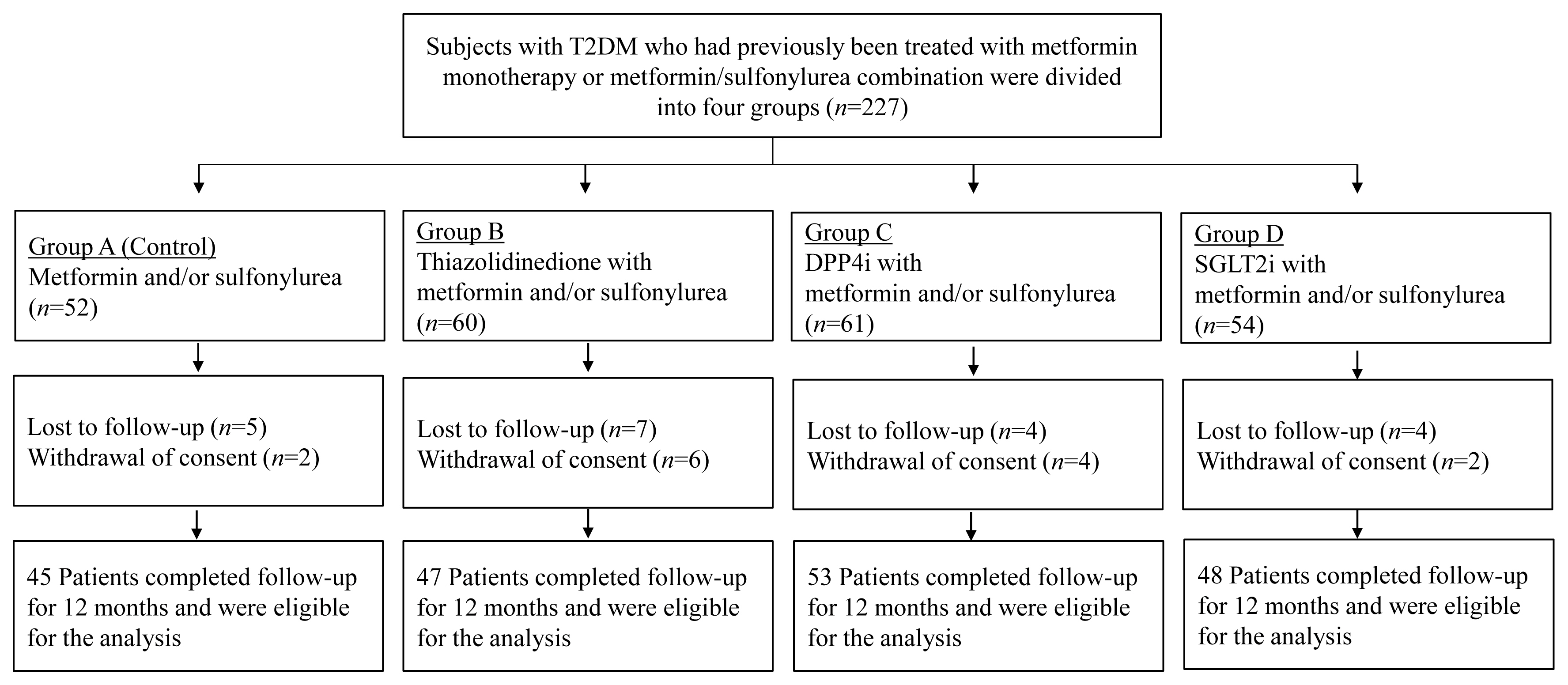
This prospective, multicenter, open-label, comparative trial included 264 patients with T2DM. Patients who had received a metformin, or sulfonylurea/metformin combination (Group 1); a thiazolidinedione combination (Group 2); a dipeptidyl peptidase-4 inhibitor (gemigliptin) combination (Group 3); or an sodium-glucose cotransporter 2 inhibitor (empagliflozin) combination (Group 4) were prospectively treated for 12 months; bone mineral density (BMD) and bone turnover marker (BTM) changes were evaluated.
Results
The femoral neck BMD percentage changes were −0.79%±2.86% (Group 1), −2.50%±3.08% (Group 2), −1.05%±2.74% (Group 3), and −1.24%±2.91% (Group 4) (P<0.05). The total hip BMD percentage changes were −0.57%±1.79% (Group 1), −1.74%±1.48% (Group 2), −0.75%±1.87% (Group 3), and −1.27%±1.72% (Group 4) (P<0.05). Mean serum BTM (C-terminal type 1 collagen telopeptide and procollagen type 1 amino-terminal propeptide) levels measured during the study period did not change over time or differ between groups.
Conclusion
Significant bone loss in the femoral neck and total hip was associated with thiazolidinedione combination regimens. However, bone loss was not significantly associated with combination regimens including gemigliptin or empagliflozin. Caution should be exercised during treatment with antidiabetic medications that adversely affect the bone in patients with diabetes at a high risk of bone loss. -
Citations
Citations to this article as recorded by- Osteoporosis risk with sodium–glucose cotransporter 2 inhibitors versus thiazolidinediones in older women with diabetes
Hyeon Jeong Lee, Pusoon Chun
Journal of Bone and Mineral Metabolism.2026; 44(3): 375. CrossRef - Dapagliflozin Improves High‐Fat Diet‐Induced Cognitive Impairment in Female Mice
Xiaolin Chen, Mingxia Fan, Zhuoni Xiao, Xiaoxing Xiong
Brain and Behavior.2025;[Epub] CrossRef - Proteases and Osteoporosis: A Comprehensive Review of Their Role in Bone Health
Syed Sufian Ahmad, Faraha Ahmed, Sayeed Ahmad, Mohammad Ahmed Khan
Current Drug Targets.2025; 26(7): 489. CrossRef - Meta-Analysis on the Association Between DPP-4 Inhibitors and Bone Mineral Density and Osteoporosis
Lili Huang, Wei Zhong, Xinghuan Liang, Huijuan Wang, Shi-en Fu, Zuojie Luo
Journal of Clinical Densitometry.2024; 27(1): 101455. CrossRef - A multicentre, double‐blind, placebo‐controlled, randomized, parallel comparison, phase 3 trial to evaluate the efficacy and safety of pioglitazone add‐on therapy in type 2 diabetic patients treated with metformin and dapagliflozin
Soo Lim, Seung‐Hwan Lee, Kyung‐Wan Min, Chang Beom Lee, Sang Yong Kim, Hye Jin Yoo, Nan Hee Kim, Jae Hyeon Kim, Seungjoon Oh, Jong Chul Won, Hyuk Sang Kwon, Mi Kyung Kim, Jung Hwan Park, In‐Kyung Jeong, Sungrae Kim
Diabetes, Obesity and Metabolism.2024; 26(6): 2188. CrossRef - Bone Loss in Diabetes Mellitus: Diaporosis
Krisztina Kupai, Hsu Lin Kang, Anikó Pósa, Ákos Csonka, Tamás Várkonyi, Zsuzsanna Valkusz
International Journal of Molecular Sciences.2024; 25(13): 7269. CrossRef - The multiple actions of dipeptidyl peptidase 4 (DPP-4) and its pharmacological inhibition on bone metabolism: a review
L. M. Pechmann, F. I. Pinheiro, V. F. C. Andrade, C. A. Moreira
Diabetology & Metabolic Syndrome.2024;[Epub] CrossRef - The effect of antidiabetic drugs on bone metabolism: a concise review
Stavroula Psachna, Maria Eleni Chondrogianni, Konstantinos Stathopoulos, Antonis Polymeris, Antonios Chatzigeorgiou, Efstathios Chronopoulos, Symeon Tournis, Eva Kassi
Endocrine.2024; 87(3): 907. CrossRef - Responsible Use of Oral Corticosteroids in People with Comorbid Diabetes: An Expert Consensus
Banshi Saboo, Shashank Joshi, Amit Gupta, Anuj Maheshwari, Bharat Saboo, Brij Mohan Makkar, Ganapathi Bantwal, Jothydev Kesavadev, L Sreenivasamurthy, Mangesh Tiwaskar, Manoj Chawla, Minakshisundaram Shunmugavelu, Nagendra Kumar Singh, Pratap Jethwani, Sa
Journal of the Association of Physicians of India.2024; 72(7): 79. CrossRef - Association of Bone Turnover Markers with Type 2 Diabetes Mellitus and Microvascular Complications: A Matched Case-Control Study
Yilin Hou, Xiaoyu Hou, Qian Nie, Qiuyang Xia, Rui Hu, Xiaoyue Yang, Guangyao Song, Luping Ren
Diabetes, Metabolic Syndrome and Obesity.2023; Volume 16: 1177. CrossRef - Complementary effects of dapagliflozin and lobeglitazone on metabolism in a diet-induced obese mouse model
Yun Kyung Lee, Tae Jung Oh, Ji In Lee, Bo Yoon Choi, Hyen Chung Cho, Hak Chul Jang, Sung Hee Choi
European Journal of Pharmacology.2023; 957: 175946. CrossRef
- Osteoporosis risk with sodium–glucose cotransporter 2 inhibitors versus thiazolidinediones in older women with diabetes
Case Report
- Thyroid
- Refractory Graves' Disease Successfully Cured by Adjunctive Cholestyramine and Subsequent Total Thyroidectomy
- Yeoree Yang, Seawon Hwang, Minji Kim, Yejee Lim, Min-Hee Kim, Sohee Lee, Dong-Jun Lim, Moo-Il Kang, Bong-Yun Cha
- Endocrinol Metab. 2015;30(4):620-625. Published online December 31, 2015
- DOI: https://doi.org/10.3803/EnM.2015.30.4.620
- 13,207 View
- 133 Download
- 17 Web of Science
- 15 Crossref
-
Abstract
PDFPubReader
The three major forms of treatment for Graves thyrotoxicosis are antithyroid drugs, radioactive iodine therapy and thyroidectomy. Surgery is the definitive treatment for Graves thyrotoxicosis that is generally recommended when other treatments have failed or are contraindicated. Generally, thyrotoxic patients should be euthyroid before surgery to minimize potential complications which usually requires preoperative management with thionamides or inorganic iodine. But several cases of refractory Graves' disease have shown resistance to conventional treatment. Here we report a 40-year-old female patient with Graves' disease who complained of thyrotoxic symptoms for 7 months. Her thyroid function test and thyroid autoantibody profiles were consistent with Graves' disease. One kind of thionamides and β-blocker were started to control her disease. However, she was resistant to nearly all conventional medical therapies, including β-blockers, inorganic iodine, and two thionamides. She experienced hepatotoxicity from the thionamides. What was worse is her past history of serious allergic reaction to corticosteroids, which are often used to help control symptoms. A 2-week regimen of high-dose cholestyramine improved her uncontrolled thyrotoxicosis and subsequent thyroidectomy was successfully performed. In conclusion, cholestyramine could be administered as an effective and safe adjunctive agent for preoperative preparation in patients with severe hyperthyroid Graves's disease that is resistant to conventional therapies.
-
Citations
Citations to this article as recorded by- Cholestyramine in Hyperthyroidism and Thyrotoxicosis: Have You Ever Used It?
Giona Castagna, Lucrezia Zanchi, Alessandro Rossini, Sara Cassibba, Roberto Trevisan, Silvia Ippolito
Endocrines.2025; 6(3): 30. CrossRef - Enhanced predictive validity of integrative models for refractory hyperthyroidism considering baseline and early therapy characteristics: a prospective cohort study
Xinpan Wang, Tiantian Li, Yue Li, Qiuyi Wang, Yun Cai, Zhixiao Wang, Yun Shi, Tao Yang, Xuqin Zheng
Journal of Translational Medicine.2024;[Epub] CrossRef - Refractory Graves’ Disease in an Adolescent Successfully Treated With Cholestyramine and Subsequent Thyroidectomy
Raghad Alsaidalani, Hesham Eltomy, Alaa B Aljuhani, Moutaz Osman
Cureus.2024;[Epub] CrossRef - Non-thionamide antithyroid drug options in Graves’ hyperthyroidism
Aliya Ruslan, Onyebuchi E Okosieme
Expert Review of Endocrinology & Metabolism.2023; 18(1): 67. CrossRef - Gestione clinica dell’ipertiroidismo refrattario
Daniela Gallo, Federica Martina Bianchi, Francesca Manzella La Barbera, Ilaria Clementi, Adriana Lai, Eliana Piantanida, Maria Laura Tanda
L'Endocrinologo.2023; 24(2): 167. CrossRef - Carbimazole-Resistant Grave’s Thyrotoxicosis is a Diagnostic and Therapeutic Dilemma, Case Report with Literature Review
Fateen Ata, Adeel Ahmad Khan, Shuja Tahir, Zaina Al Amer
International Medical Case Reports Journal.2023; Volume 16: 783. CrossRef - Medical treatment of thyrotoxicosis
Lorenzo SCAPPATICCIO, Giuseppe BELLASTELLA, Maria I. MAIORINO, Luca GIOVANELLA, Katherine ESPOSITO
The Quarterly Journal of Nuclear Medicine and Molecular Imaging.2021;[Epub] CrossRef - THERAPEUTIC EFFECTS OF COMBINATION REGIMENS INCLUDING METHIMAZOLE ON GRAVES HYPERTHYROIDISM: A NETWORK META-ANALYSIS OF RANDOMIZED CONTROLLED TRIALS
Maorong Wang, Yerong Yu
Endocrine Practice.2020; 26(6): 675. CrossRef - Cholestyramine alters bile acid amounts and the expression of cholesterol‐related genes in rabbit intestinal and hepatic tissues
Dong Ni Qiu, Quan Shang, Da Yu Sun, Wei Qun Ding, Zhong Guang Luo, Jian Chen, Wei Ru Jiang, Jian Ping Huang, Xiao Yun Jiang
Journal of Digestive Diseases.2017; 18(2): 107. CrossRef - ENDOCRINOLOGY IN PREGNANCY: Pregnancy and the incidence, diagnosing and therapy of Graves’ disease
Peter Laurberg, Stine Linding Andersen
European Journal of Endocrinology.2016; 175(5): R219. CrossRef - 2016 American Thyroid Association Guidelines for Diagnosis and Management of Hyperthyroidism and Other Causes of Thyrotoxicosis
Douglas S. Ross, Henry B. Burch, David S. Cooper, M. Carol Greenlee, Peter Laurberg, Ana Luiza Maia, Scott A. Rivkees, Mary Samuels, Julie Ann Sosa, Marius N. Stan, Martin A. Walter
Thyroid®.2016; 26(10): 1343. CrossRef - Cholestyramine Use for Rapid Reversion to Euthyroid States in Patients with Thyrotoxicosis
Jeonghoon Ha, Kwanhoon Jo, Borami Kang, Min-Hee Kim, Dong-Jun Lim
Endocrinology and Metabolism.2016; 31(3): 476. CrossRef - The role of bile acids in metabolic regulation
Libor Vítek, Martin Haluzík
Journal of Endocrinology.2016; 228(3): R85. CrossRef - Recent Advances in Autoimmune Thyroid Diseases
Won Sang Yoo, Hyun Kyung Chung
Endocrinology and Metabolism.2016; 31(3): 379. CrossRef - A Case of Methimazole-Resistant Severe Graves' Disease: Dramatic Response to Cholestyramine
Seung Byung Chae, Eun Sook Kim, Yun Im Lee, Bo Ram Min
International Journal of Thyroidology.2016; 9(2): 190. CrossRef
- Cholestyramine in Hyperthyroidism and Thyrotoxicosis: Have You Ever Used It?
 First
 Prev




