
 KES

Search
- Page Path
- HOME > Search
Original Articles
- Thyroid
- Prognosis of Poorly Differentiated Thyroid Carcinoma: A Systematic Review and Meta-Analysis
- Ji Young Kim, Jae Kyung Myung, Soyun Kim, Kyung Tae, Yun Young Choi, Soo Jin Lee
- Endocrinol Metab. 2024;39(4):590-602. Published online June 27, 2024
- DOI: https://doi.org/10.3803/EnM.2024.1927

- 19,338 View
- 324 Download
- 8 Web of Science
- 8 Crossref
-
 Abstract
 PDF
 Supplementary Material
 PubReader
 ePub
- Background
Poorly differentiated thyroid carcinoma (PDTC) accounts for a small portion of thyroid carcinomas but contributes to a significant proportion of thyroid carcinoma-associated deaths. The clinicopathological prognostic factors and clinical outcomes of PDTC remain unclear. We aimed to evaluate the clinical outcomes of patients with PDTC after curative treatment.
Methods
A comprehensive search was performed up to September 2023. We included studies investigating treatment outcomes in patients with PDTC who underwent initial surgery. The 5-year disease-free survival (DFS) and overall survival (OS) were extracted. In this meta-analysis, the enrolled PDTC histological criteria included 3rd, 4th, and 5th World Health Organization (WHO) and Memorial Sloan Kettering Cancer Center (MSKCC) classification. A random-effects model was used for the pooled proportion analysis. Meta-regression analysis was conducted to evaluate the prognostic factors.
Results
Twenty retrospective studies published between 2007 and 2023, including 1,294 patients, met all inclusion criteria. Studies that diagnosed PDTC based on various histological criteria including 3rd WHO (n=5), 4th WHO (n=12), 5th WHO (n=2), and MSKCC (n=1) were included. Overall, 5-year DFS and 5-year OS were 49.4% (95% confidence interval [CI], 42.3 to 56.4) and 73.8% (95% CI, 66.5 to 79.9), with moderate heterogeneity of 58% and 55%, respectively. In meta-regression analysis, extrathyroidal extension (ETE) was a prognostic factor for OS.
Conclusion
The meta-analysis of DFS and OS in patients with PDTC show the moderate heterogeneity with a variety of histological criteria. ETE appears to have a significant impact on OS, regardless of histological criteria. -
Citations
Citations to this article as recorded by
- Differentiated high-grade thyroid carcinoma (DHGTC): clinicopathological analysis of a new entity in a chilean center
Marlín Solórzano, Ignacio Fuentes, José Miguel González, Nicole Lustig, Lorena Mosso, Joel Falcón, Catalina Ruiz, Joaquín Viñambres, Rodolfo Cabello, Hernán González, Pablo H Montero, Francisco Cruz, Rodrigo Jaimovich, Juan Carlos Quintana, Antonieta Sola
Endocrine.2026;[Epub] CrossRef - Poorly differentiated thyroid carcinoma in identical twins: a report of two cases and review of the literature
Amal El Masri, Celine El Moughrabi, Anas El Zouhbi, Anthony Shebly, Hala Kassouf, Mustafa Natout, Yusef Hazimeh, Mustapha El Lakis
Thyroid Research.2026;[Epub] CrossRef - Clinical and prognostic characteristics of poorly differentiated thyroid carcinomas
B.B. Guda, A.V. Tymkiv, M.V. Ostafiychuk, I.I. Komisarenko, I.V. Gamezardashvili, M.D. Melnik
INTERNATIONAL JOURNAL OF ENDOCRINOLOGY (Ukraine).2026; 22(2): 111. CrossRef - Embryonic reprogramming drives anaplastic transformation in thyroid carcinoma
Ryo Kawaura, Akari Unome, Hiroyuki Tomita, Hiromasa Ishihara, Masashi Kuroki, Shingo Komura, Koki Kato, Shigeo Takashima, Naoki Nishio, Mayu Shigeyama, Tomoya Hirata, Ryo Ishii, Shioko Kimura, Shin Tsunekawa, Haruhiko Akiyama, Akira Hara, Yasuhiro Yamada,
Cell Reports.2026; 45(11): 118195. CrossRef - Multilayered Insights into Poorly Differentiated, BRAFV600E-Positive, Thyroid Carcinoma in a Rapidly Developing Goiter with Retrosternal Extension: From En “Y” Cervicotomy to SPECT/CT-Positive Lung Metastases
Oana-Claudia Sima, Anca-Pati Cucu, Dana Terzea, Claudiu Nistor, Florina Vasilescu, Lucian-George Eftimie, Mihai-Lucian Ciobica, Mihai Costachescu, Mara Carsote
Diagnostics.2025; 15(16): 2049. CrossRef - GDF15 is associated with thyroid cancer progression and may modulate thyroid cancer cell senescence in a p53-dependent manner
Jingyu Ma, Zishuo Liu, Rui Hua, Changyuan Ding, Zhenpeng Yang, Weili Liang, Bin Lv
Frontiers in Endocrinology.2025;[Epub] CrossRef - Multimodal spectrum of approach in poorly differentiated thyroid carcinoma (an updated analysis)
Mihai Costachescu, Nina Ionovici , Dana Cristina Terzea , Florina Vasilescu , Lucian-George Eftimie , Alexandra-Ioana Trandafir , Ana-Maria Gheorghe , Oana-Claudia Sima , Claudiu Nistor , Mara Carsote
Romanian Journal of Morphology and Embryology.2025; 66(3): 431. CrossRef - Aggressive Types of Malignant Thyroid Neoplasms
Maria Boudina, Eleana Zisimopoulou, Persefoni Xirou, Alexandra Chrisoulidou
Journal of Clinical Medicine.2024; 13(20): 6119. CrossRef
- Differentiated high-grade thyroid carcinoma (DHGTC): clinicopathological analysis of a new entity in a chilean center

- Clinical Study
- Fasting and Postprandial Hyperglycemia: Their Predictors and Contributions to Overall Hyperglycemia in Korean Patients with Type 2 Diabetes
- Jaecheol Moon, Ji Young Kim, Soyeon Yoo, Gwanpyo Koh
- Endocrinol Metab. 2020;35(2):290-297. Published online June 24, 2020
- DOI: https://doi.org/10.3803/EnM.2020.35.2.290
- 18,092 View
- 276 Download
- 10 Web of Science
- 11 Crossref
-
Abstract
PDFPubReader ePub
- Background
This study aimed to identify factors that affect fasting hyperglycemia (FHG) and postprandial hyperglycemia (PPG) and their contributions to overall hyperglycemia in Korean patients with type 2 diabetes mellitus (T2DM).
Methods
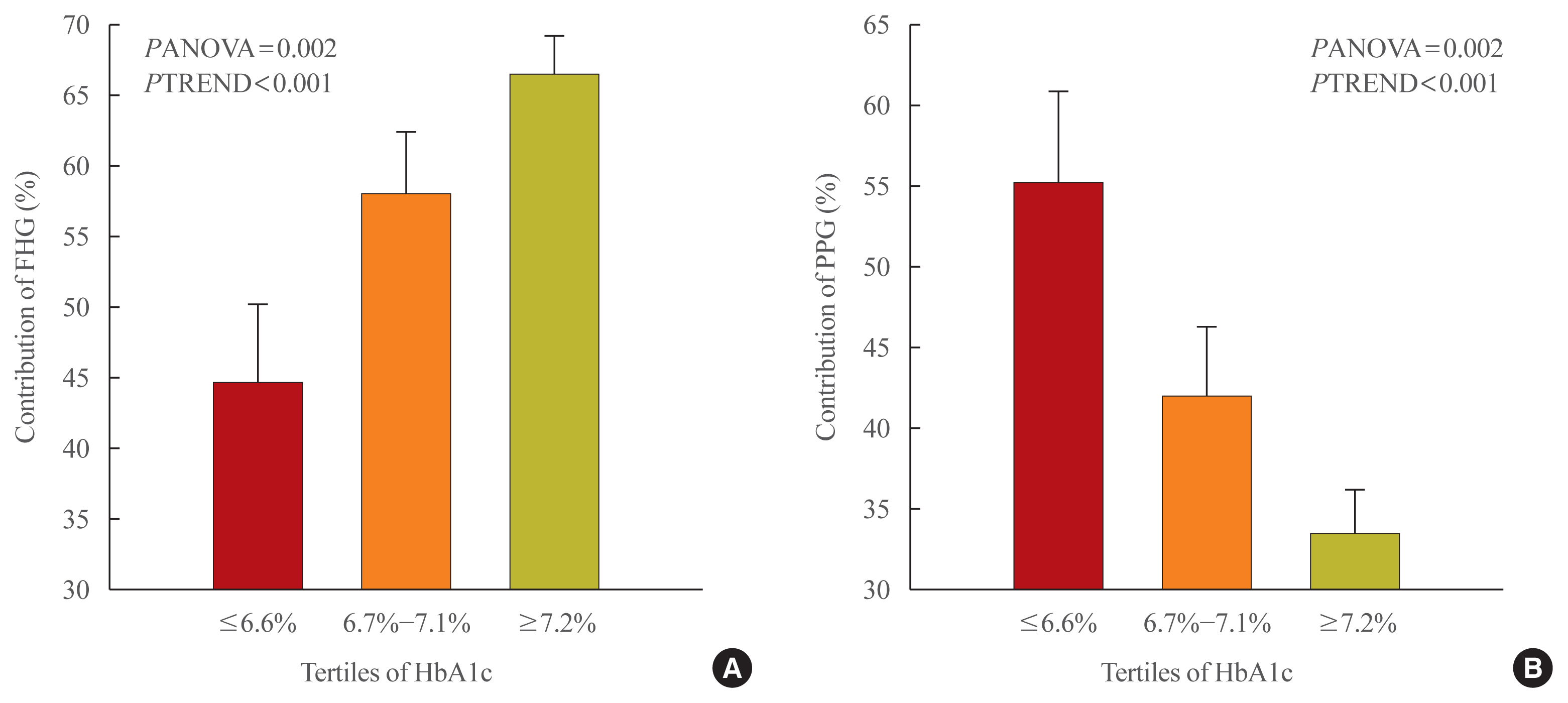
This was a retrospective study conducted on 194 Korean T2DM patients with 7-point self-monitoring blood glucose (SMBG) profiles plotted in 4 days in 3 consecutive months. We calculated the areas corresponding to FHG and PPG (area under the curve [AUC]FHG and AUCPPG) and contributions (%) in the graph of the 7-point SMBG data. The levels of glycated hemoglobin (HbA1c) were categorized by tertiles, and the contributions of FHG and PPG were compared.
Results
The relative contribution of FHG increased (44.7%±5.6%, 58.0%±4.4%, 66.5%±2.8%; PANOVA=0.002, PTREND <0.001), while that of PPG decreased (55.3%±5.5%, 42.0%±4.4%, 33.5%±2.8%; PANOVA=0.002, PTREND <0.001) with the elevated HbA1c. Multivariate analysis showed that HbA1c (β=0.615, P<0.001), waist circumference (β=0.216, P=0.042), and triglyceride (β=0.121, P=0.048) had a significant association with AUCFHG. Only HbA1c (β=0.231, P=0.002) and age (β=0.196, P=0.009) was significantly associated with AUCPPG.
Conclusion
The data suggested that in Korean T2DM patients, FHG predominantly contributed to overall hyperglycemia at higher HbA1c levels, whereas it contributed to PPG at lower HbA1c levels. It is recommended that certain factors, namely age, degree of glycemic control, obesity, or triglyceride levels, should be considered when prescribing medications for T2DM patients. -
Citations
Citations to this article as recorded by- Effect of a Digital-Driven Physician-Pharmacist Collaborative Model for Diabetes in Primary Health Care: Cluster Randomized Trial
Jie Xiao, Qing Wang, Shenglan Tan, Lei Chen, Daxiong Xiang, Haiyan Yuan, Xia Li, Shuting Huang, Bingjie Tang, Yan Guo, Haiying Huang, Danhui Zhao, Yue Li, Li Wang, Qun Li, Juan Liu, Ping Xu
Journal of Medical Internet Research.2026; 28: e77470. CrossRef - Association between stress hyperglycemia ratio and cognitive function in older patients with diabetes or prediabetes: a cross-sectional study from the NHANES
Luwen Zou, Weiguang Ye, Chao Li, Shuai Yang
Endocrine Journal.2026; 73(6): 691. CrossRef - Eryngium species in diabetes management: a systematic review of ethnopharmacological evidence and mechanisms of action
Fernanda Artemisa Espinoza-Hernández, Adolfo Andrade-Cetto
Journal of Ethnopharmacology.2026; 370: 122049. CrossRef - Metabolomic Profiling of Gestational Diabetes Mellitus and Its Subtypes Among Chinese Pregnant Women
Xialidan Alifu, Yiwen Qiu, Boya Wang, Nuo Xu, Shuhui Wang, Haoyue Cheng, Ye Huang, Libi Zhang, Diliyaer Ainiwan, Haibo Zhou, Hui Liu, Danqing Chen, Yunxian Yu
Life.2026; 16(10): 1641. CrossRef - Basal Hyperglycemia Contributes More Than 50% to Time in Range in Pregnant Women With Type 1 Diabetes
Ping Ling, Daizhi Yang, Chaofan Wang, Xueying Zheng, Sihui Luo, Xubin Yang, Hongrong Deng, Wen Xu, Jinhua Yan, Jianping Weng
The Journal of Clinical Endocrinology & Metabolism.2024; 109(12): 3264. CrossRef - Restriction of Rice Portion and Pre-Meal Fruit with HbA1c Levels and Abdominal Fat for Diabetics in Malang City
Dwipajati Dwipajati, Sutomo Rum Teguh Kaswari
Amerta Nutrition.2024; 8(1): 58. CrossRef - Prospective study of the association between chronotype and cardiometabolic risk among Chinese young adults
Tingting Li, Yang Xie, Shuman Tao, Liwei Zou, Yajuan Yang, Fangbiao Tao, Xiaoyan Wu
BMC Public Health.2023;[Epub] CrossRef - Effects of mulberry twig alkaloids(Sangzhi alkaloids) and metformin on blood glucose fluctuations in combination with premixed insulin-treated patients with type 2 diabetes
Ziyu Meng, Chengye Xu, Haoling Liu, Xinyuan Gao, Xinyu Li, Wenjian Lin, Xuefei Ma, Changwei Yang, Ming Hao, Kangqi Zhao, Yuxin Hu, Yi Wang, Hongyu Kuang
Frontiers in Endocrinology.2023;[Epub] CrossRef - Evaluating Triglyceride and Glucose Index as a Simple and Easy-to-Calculate Marker for All-Cause and Cardiovascular Mortality
Kyung-Soo Kim, Sangmo Hong, You-Cheol Hwang, Hong-Yup Ahn, Cheol-Young Park
Journal of General Internal Medicine.2022; 37(16): 4153. CrossRef - A new approach for investigating the relative contribution of basal glucose and postprandial glucose to HbA1C
Jing Ma, Hua He, Xiaojie Yang, Dawei Chen, Cuixia Tan, Li Zhong, Qiling Du, Xiaohua Wu, Yunyi Gao, Guanjian Liu, Chun Wang, Xingwu Ran
Nutrition & Diabetes.2021;[Epub] CrossRef - The Clinical Characteristics of Gestational Diabetes Mellitus in Korea: A National Health Information Database Study
Kyung-Soo Kim, Sangmo Hong, Kyungdo Han, Cheol-Young Park
Endocrinology and Metabolism.2021; 36(3): 628. CrossRef
- Effect of a Digital-Driven Physician-Pharmacist Collaborative Model for Diabetes in Primary Health Care: Cluster Randomized Trial
Case Reports
- A Case of Addison's Disease due to Tuberculosis.
- Ji Young Kim, Ho Choon Jeon, Kyeong Young Kim, Sung Eun Cha, Hyung Seok Choi, In Sohn, Ka Hee Yi
- J Korean Endocr Soc. 1994;10(3):306-310. Published online November 6, 2019
- 1,923 View
- 36 Download
-
Abstract
PDF
- We reported a case of Addison's disease due to tuberculosis, which was pathologically confirmed by fine-needle aspiration biopsy. In a 39-year-old man with fatigue, weakness, and generalized cutaneous pigmentation, the diagnosis of Addison's disease was made by the finding of elevated plasma ACTH level and subnormal response to rapid ACTH test. Computed tomographic scan revealed bilateral adrenal mass with heterogenous uptake and peripheral rim enhancement, and calcification. Ultrasoundguided fine-deedle aspiration biopsy of the left adrenal mass disclosed granulomatous inflammation with caseation necrosis. The patient also had active tuberculosis in the right inguinal lymph node.
- A Case of Adrenal Teratoma.
- Ji young Kim, Youn zoo Cho, Kang Woo Lee, Dong Mee Lim, Keun Young Park, Byung Joon Kim
- Endocrinol Metab. 2011;26(3):272-275. Published online September 1, 2011
- DOI: https://doi.org/10.3803/EnM.2011.26.3.272
- 96,753 View
- 27 Download
- 2 Crossref
-
Abstract
PDF
- Teratoma is a congenital tumor containing tissues derived from all germ layers. Teratoma in the region of the adrenal gland is a very uncommon retroperitoneal tumor. Only 7 cases of adrenal teratoma have been reported worldwide, but in Korea, no similar cases have been reported until now. This case report describes an adrenal teratoma in a 38-year-old healthy woman who was incidentally diagnosed with a left adrenal mass on abdominal ultrasonography during a medical inspection. Computed tomographic scans revealed a 9-cm heterogeneous circumscribed round mass, containing primarily fat tissue, and a solid calcification component in the left adrenal gland. Adrenal hormonal assessment results and biochemical markers for gonadal neoplasia were negative. Result of serum laboratory tests were normal. The patient underwent laparoscopic adrenalectomy. Histologic analysis confirmed the diagnosis of a mature teratoma; the obtained specimen measured 5 x 7 x 7.5 cm and weighed 267 g. The surface of the mass was smooth, and sebaceous tissue and hair with hard material were observed on the incisional surface. The patient was discharged on postoperative day 4, without complications. In this case report, we describe the incidental finding of a teratoma occurring in the adrenal gland region in a healthy woman; the teratoma was laparoscopically excised.
-
Citations
Citations to this article as recorded by- Lipomatous tumours in adrenal gland: WHO updates and clinical implications
Alfred King-yin Lam
Endocrine-Related Cancer.2017; 24(3): R65. CrossRef - A Case of Teratoma of Thyroid Gland in Adolescence
Yu-Chang Lee, Su-Jin Jeong, Sol-Jae Lee, Chong-Hwa Kim, Yong-Hoon Lee, Jung-Eun Lee, Hye-Ji Seo
International Journal of Thyroidology.2017; 10(1): 61. CrossRef
- Lipomatous tumours in adrenal gland: WHO updates and clinical implications
- A Case of Primary Aldosteronism with Aortic Dissection.
- Jung Hyun Seo, Ji Young Kim, Young Sup Kim, Wan Suk Kim, Jin Hyang Shin, Dong Jik Ahn, Yoon Young Cho, Sung Hwan Park, Jae Bok Park, Hyun Dae Yoon, Ji Hyun Lee, Ho Sang Shon
- J Korean Endocr Soc. 2004;19(4):452-457. Published online August 1, 2004
- 2,049 View
- 24 Download
-
Abstract
PDF
- Hypertension and atherosclerosis are the most important factors contributing to the development of aortic dissection. Primary aldosteronism is a rare cause of hypertension. The concurrence of aortic dissection is very rare in primary aldosteronism. However, when aortic dissection is found as a life-threatening complication of primary aldosteronism, then the diagnosis of primary aldosteronism is important because the therapeutic intervention can be curative. Only 3 cases of primary aldosteronism with aortic dissection have been reported in the literature. We report here on a case of primary aldosteronism with aortic dissection, which was treated by laparoscopic adrenalectomy. We lowered the blood pressure with antihypertensive drugs and potassium replacement was done to treat the aortic dissection. After stabilization of aortic dissection, we removed his left adrenal mass by laparoscopic adrenalectomy. Postoperatively, the patient's blood pressure has been within normal limits and the serum potassium increased to a normal level without supplementation. The aortic dissection has remained in a stable state
 First
 Prev




