
 KES

Search
- Page Path
- HOME > Search
Review Articles
- Thyroid
- Korean Thyroid Association Guidelines on the Management of Differentiated Thyroid Cancers, Part II: Follow-up Surveillance after Initial Treatment 2026
- Eun Kyung Lee, Seung Heon Kang, Bon Seok Koo, Mijin Kim, Min Joo Kim, Bo Hyun Kim, Ji Won Kim, Dong Gyu Na, Sohyun Park, Ji-In Bang, Kyorim Back, Youngduk Seo, Young-Ik Son, Young Shin Song, Dong Yeob Shin, Jong-hyuk Ahn, Hwa Young Ahn, So Won Oh, Ho-Ryun Won, Won Sang Yoo, Min Kyoung Lee, Sang-Woo Lee, Jeongmin Lee, Ji Ye Lee, Dong-Jun Lim, Ki-Wook Chung, Ari Chong, Jin Hyang Jung, Sun Wook Cho, Yoon Young Cho, Chae Moon Hong, Young Joo Park, Korean Thyroid Association Guideline Committee on the Management of Thyroid Nodule and Cancer
- Endocrinol Metab. 2026;41(4):493-534. Published online August 31, 2026
- DOI: https://doi.org/10.3803/EnM.2026.3149

- 2,291 View
- 119 Download
- 2 Web of Science
- 1 Crossref
-
 Abstract
 PDF
 PubReader
 ePub
- In patients with differentiated thyroid cancer, initial recurrence-risk stratification based on clinical, histopathological, and perioperative findings remains central to management during the first 1–2 years after initial treatment. Ongoing risk stratification (ORS) complements this initial assessment by continuously integrating longitudinal clinical data and treatment response, thereby refining long-term prognostic assessment and supporting individualized risk-adapted management. Building on the 2024 Korean Thyroid Association (KTA) guidelines, the 2026 KTA guideline incorporates new evidence from large Korean multicenter cohorts and comprehensive systematic reviews. The updated recommendations reinforce the continued application of ORS and provide more specific guidance on risk-adapted thyroid-stimulating hormone (TSH) targets, surveillance strategies for recurrence detection, and long-term follow-up tailored to individual recurrence risk and treatment response. Consistent with the evolving paradigm toward risk-adapted and individualized management, this revision updates recommendations regarding target serum TSH levels, serum thyroglobulin thresholds for response assessment and long-term surveillance, and follow-up intervals based on both initial-risk category and the ORS response category. These evidence-based recommendations aim to minimize unnecessary treatment and excessive surveillance in the majority of patients who have an excellent prognosis after initial therapy while ensuring individualized long-term management for patients who require closer surveillance or additional therapeutic intervention.
-
Citations
Citations to this article as recorded by
- Postoperative Surveillance in Differentiated Thyroid Cancer: Response-Adapted De-Escalation in the 2025 American Thyroid Association and 2026 Korean Thyroid Association Guidelines
Sun Wook Cho
Endocrinology and Metabolism.2026; 41(4): 535. CrossRef
- Postoperative Surveillance in Differentiated Thyroid Cancer: Response-Adapted De-Escalation in the 2025 American Thyroid Association and 2026 Korean Thyroid Association Guidelines

- Thyroid
- 2025 Korean Thyroid Association Clinical Management Guideline on Active Surveillance for Low-Risk Papillary Thyroid Carcinoma
- Eun Kyung Lee, Min Joo Kim, Seung Heon Kang, Bon Seok Koo, Kyungsik Kim, Mijin Kim, Bo Hyun Kim, Ji-hoon Kim, Shinje Moon, Kyorim Back, Young Shin Song, Jong-hyuk Ahn, Hwa Young Ahn, Ho-Ryun Won, Won Sang Yoo, Min Kyoung Lee, Jeongmin Lee, Ji Ye Lee, Kyong Yeun Jung, Chan Kwon Jung, Yoon Young Cho, Dong-Jun Lim, Sun Wook Kim, Young Joo Park, Dong Gyu Na, Jee Soo Kim
- Endocrinol Metab. 2025;40(3):307-341. Published online June 24, 2025
- DOI: https://doi.org/10.3803/EnM.2025.2461

- 24,236 View
- 715 Download
- 13 Web of Science
- 15 Crossref
-
Abstract
PDFPubReader ePub
- The increasing detection of papillary thyroid microcarcinoma (PTMC) has raised concerns regarding overtreatment. For low-risk PTMC, either immediate surgery or active surveillance (AS) can be considered. To facilitate the implementation of AS, the Korean Thyroid Association convened a multidisciplinary panel and developed the first Korean guideline. AS is recommended for adults with pathologically confirmed Bethesda V–VI PTMC who have no clinical evidence of lymph node or distant metastasis, gross extrathyroidal extension, invasion of the trachea or recurrent laryngeal nerve, or aggressive histology. A baseline assessment requires high-resolution neck ultrasound performed by experienced operators to exclude extrathyroidal extension, tracheal or recurrent laryngeal nerve invasion, and lymph node metastasis; contrast-enhanced neck computed tomography is optional. Patient characteristics, including age, comorbidities, and the capacity for long-term follow-up, should be thoroughly assessed. Shared decision-making should carefully weigh the benefits and risks of surgery versus AS, considering expected oncologic outcomes, potential complications, quality of life, anxiety, medical costs, and patient preference. Follow-up involves neck ultrasound and thyroid function tests every 6 months for 2 years and annually thereafter. Disease progression, defined as significant tumor growth or newly detected nodal or distant metastasis, warrants surgery. Despite remaining uncertainties, this guideline provides a structured framework to ensure oncologic safety and supports patient-centered AS.
-
Citations
Citations to this article as recorded by- Feasibility and Safety of Active Surveillance in Subcapsular Thyroid Nodules with High Suspicion for Malignancy
Yan Hu, Wei Zhou, Lu Zhang, Weiwei Zhan
Ultrasound in Medicine & Biology.2026; 52(4): 816. CrossRef - Combined Ultrasound and MRI Assessment in Patients Undergoing Reoperation for Recurrent Papillary Thyroid Carcinoma: Oncological Outcomes and Surgical Safety
Zimei Tang, Jie Liu, Rong Wang, Gang Tian, Anwen Ren, Jiexiao Li, Yiran Wang, Wen Yang, Peng Sun, Tao Huang, Ximeng Zhang, Jie Ming
Current Oncology.2026; 33(2): 98. CrossRef - Multidisciplinary team diagnosis and treatment of well-differentiated thyroid carcinoma: current landscape and future prospects
Yuanyuan Li, Peijie Wang, Jiaxin Cao, Haiyan Liu
The Oncologist.2026;[Epub] CrossRef - Controlled minimally invasive surgical interventions for the treatment of patients with thyroid carcinoma
David D. Dolidze, Zurab A. Bagatelia, Suren G. Laboyan, Arshak V. Vardanyan, Konstantin S. Titov, Ivan N. Lebedinsky, Georgi Genadi Melkonyan, Dmitriy V. Matveev, Nodar N. Gogitidze, Andrei Y. Lukin, Armen R. Oganyan, David G. Gogolashvili, Anastasia V. B
Journal of Experimental and Clinical Surgery.2026; 19(1): 45. CrossRef -
Overdiagnosis and Overtreatment of Thyroid Cancer and Precision
Mitigation Strategies—An Integrated Analysis Based on Evidence-Based Medicine and Risk Stratification Models
云菲 李
Advances in Clinical Medicine.2026; 16(04): 4980. CrossRef - Active surveillance for low-risk papillary thyroid carcinoma: Integrating guidelines, emerging evidence, and directions
Zijing Wu, Kaiang Zhang, Huixian Zhou, Leyi Wan, Jingyuan Zhong, Chunhua Li, Lianggeng Gong, Yun Peng
iScience.2026; 29(6): 115832. CrossRef - Prognostic Factors and Recurrence in Papillary Thyroid Microcarcinoma
Aydan Farzaliyeva, Feride Pınar Altay, Ozlem Turhan Iyidir, Neslihan Bascil Tutuncu
Medicina.2026; 62(5): 981. CrossRef - Response to “Balancing Sensitivity and Overtreatment in Preoperative CT Evaluation for Papillary Thyroid Microcarcinoma”
Young Hun Jeon, Ji Ye Lee
Korean Journal of Radiology.2026; 27(9): 908. CrossRef - A novel cartilage-based reference point for the recurrent laryngeal nerve: implication for preoperative risk stratification in posterior subcapsular thyroid tumors
Qianqian Lu, Feiliang Wang, Xiaoquan Zhu, Jiankun Li, Weijing Li, Dongdong Wang, Yao Li, Yanyang Zhao, Gang Miao
World Journal of Surgical Oncology.2026;[Epub] CrossRef - Risk factors associated with lymph node metastasis in cN0 papillary thyroid microcarcinoma
Shijie Zheng, Chuangwu Ke, Weijing Hao, Xiaohan Chen, Wenchao Zhang
Frontiers in Oncology.2026;[Epub] CrossRef - Papillary thyroid carcinoma in a patient with long‑standing chronic lymphocytic leukemia: A case report
Jiaxiang Ma, Tieying Gan, Ailin Song, Hongyou Tian, Shaoce Xu, Lei Zhao
Oncology Letters.2026; 32(4): 1. CrossRef - Prediction of Central Lymph Node Metastasis in Papillary Thyroid Microcarcinoma Using a Deep Learning Radiomics Model Based on SAM3 Automatic Segmentation of Ultrasound Images: A Multicenter Cohort Study
Jun Song, Yuan Zhang, Xiachuan Qin, Xiaoling Liu, Fanding He
Academic Radiology.2026;[Epub] CrossRef - Radiofrequency Ablation of Calcified Papillary Thyroid Microcarcinoma: Long-Term Imaging Evolution and Clinical Outcomes
So Yeong Jeong, Sun Mi Baek, Suyoung Shin, Hyunsoo Kim, Young Hwa Suh, Jung Hwan Baek
Thyroid®.2026;[Epub] CrossRef - Optimal cutoff value of fine-needle aspiration thyroglobulin of metastatic lymph node in thyroid cancer patients
Yang Yang, Xianfeng Jiang
European Journal of Surgical Oncology.2025; 51(11): 110428. CrossRef - Low-risk thyroid cancer: surgery or active surveillance—an application of shared decision-making: a narrative review
Min Joo Kim, Eun Kyung Lee, Sun Wook Cho, Yoo Hyung Kim, Kyu Eun Lee, Su-jin Kim, Woochul Kim, Eun-Jae Chung, Jungirl Seok, Yul Hwangbo, Young Ki Lee, Jinsun Jang, Junsun Ryu, Yuh-Seog Jung, Chang Hwan Ryu, Jae Hoon Moon, June Young Choi, Hyeong Won Yu, K
Journal of the Korean Medical Association.2025; 68(9): 573. CrossRef
- Feasibility and Safety of Active Surveillance in Subcapsular Thyroid Nodules with High Suspicion for Malignancy
Original Article
- Thyroid
Big Data Articles (National Health Insurance Service Database) - Prevalence, Treatment Status, and Comorbidities of Hyperthyroidism in Korea from 2003 to 2018: A Nationwide Population Study
- Hwa Young Ahn, Sun Wook Cho, Mi Young Lee, Young Joo Park, Bon Seok Koo, Hang-Seok Chang, Ka Hee Yi
- Endocrinol Metab. 2023;38(4):436-444. Published online July 12, 2023
- DOI: https://doi.org/10.3803/EnM.2023.1684
- 11,493 View
- 248 Download
- 15 Web of Science
- 15 Crossref
-
Abstract
PDF
 Supplementary MaterialPubReader ePub
- Background
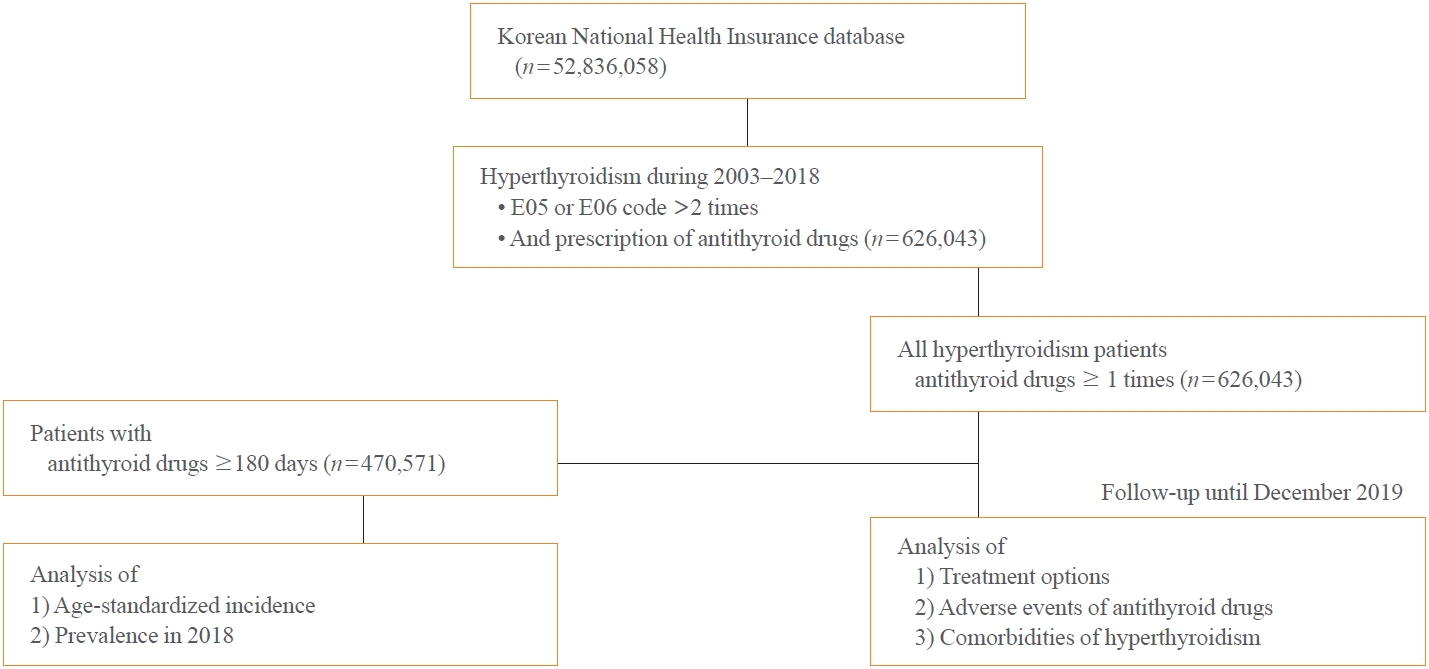
This study aimed to investigate the changes of incidence and treatment of choice for hyperthyroidism from 2003 to 2018 and explore the treatment-related complications and concomitant comorbidities in South Korea using data from the National Health Insurance Service.
Methods
This is a retrospective observational study. Hyperthyroidism was defined as a case having two or more diagnostic codes of thyrotoxicosis, with antithyroid drug intake for more than 6 months.
Results
The average age-standardized incidence of hyperthyroidism from 2003 to 2018 was 42.23 and 105.13 per 100,000 men and women, respectively. In 2003 to 2004, hyperthyroidism was most often diagnosed in patients in their 50s, but in 2017 to 2018, people were most often diagnosed in their 60s. During the entire period, about 93.7% of hyperthyroidism patients were prescribed with antithyroid drugs, and meanwhile, the annual rates of ablation therapy decrease from 7.68% in 2008 to 4.56% in 2018. Antithyroid drug-related adverse events, mainly agranulocytosis and acute hepatitis, as well as complications of hyperthyroidism such as atrial fibrillation or flutter, osteoporosis, and fractures, occurred more often in younger patients.
Conclusion
In Korea, hyperthyroidism occurred about 2.5 times more in women than in men, and antithyroid drugs were most preferred as the first-line treatment. Compared to the general population, hyperthyroid patients may have a higher risk of atrial fibrillation or flutter, osteoporosis, and fractures at a younger age. -
Citations
Citations to this article as recorded by- Association between Benign Thyroid Disorders and Breast Cancer Risk in Korean Women
Boyoung Park, Thi Xuan Mai Tran
Cancer Research and Treatment.2026; 58(1): 141. CrossRef - Nationwide Big Data Studies of Endocrine Diseases Using the Korean National Health Information Database: Research Trends and Standardization of Operational Definitions
Sun Wook Cho, Jung Hee Kim, Kyoung Jin Kim, Beom-Jun Kim, Mee Kyoung Kim, Eun Jung Rhee
Endocrinology and Metabolism.2026; 41(1): 86. CrossRef - Association between antibiotic use and Graves’ disease: a cohort study
Yaejin Son, Sun Jae Park, Ju Hyun Kang, Jina Chung, Hye Jun Kim, Jiwon Yu, Sangwoo Park, Jaewon Kim, Hyeokjong Lee, Changho Han, Young Jun Park, Hyun-Young Shin, Sang Min Park
European Journal of Endocrinology.2026; 195(3): 478. CrossRef - Effect of COVID-19 Vaccination on Thyroid Disease in 7 Million Adult and 0.2 Million Adolescent Vaccine Recipients
Sungho Bea, Hwa Young Ahn, Jieun Woo, Ju-Young Shin, Sun Wook Cho
The Journal of Clinical Endocrinology & Metabolism.2025; 110(9): e3109. CrossRef - Unveiling Risk Factors for Treatment Failure in Patients with Graves’ Disease: A Nationwide Cohort Study in Korea
Jung A Kim, Kyeong Jin Kim, Jimi Choi, Kyoung Jin Kim, Eyun Song, Ji Hee Yu, Nam Hoon Kim, Hye Jin Yoo, Ji A Seo, Nan Hee Kim, Kyung Mook Choi, Sei Hyun Baik, Sin Gon Kim
Endocrinology and Metabolism.2025; 40(1): 125. CrossRef - 2025 Korean Thyroid Association Management Guidelines for Radioactive Iodine Therapy in Patients with Hyperthyroidism
Kyeong Jin Kim, Eyun Song, Mijin Kim, Hyemi Kwon, Eu Jeong Ku, Hyun Woo Kwon, Jee Hee Yoon, Eun Kyung Lee, Won Woo Lee, Young Joo Park, Dong-Jun Lim, Sun Wook Kim, Ho-Cheol Kang, Jae Hoon Chung, Tae Yong Kim, Sin Gon Kim, Dong Gyu Na, Jee Soo Kim
International Journal of Thyroidology.2025; 18(1): 65. CrossRef - 2025 Korean Thyroid Association Management Guidelines for Radioactive Iodine Therapy in Patients with Hyperthyroidism
Kyeong Jin Kim, Eyun Song, Mijin Kim, Hyemi Kwon, Eu Jeong Ku, Hyun Woo Kwon, Jee Hee Yoon, Eun Kyung Lee, Won Woo Lee, Young Joo Park, Dong-Jun Lim, Sun Wook Kim, Ho-Cheol Kang, Jae Hoon Chung, Tae Yong Kim, Sin Gon Kim, Dong Gyu Na, Jee Soo Kim
Endocrinology and Metabolism.2025; 40(3): 342. CrossRef - A Digital Software Support Platform for Hyperthyroidism Management in South Korea: Markov Simulation Model-Based Cost-Effectiveness Analysis
Jung Hyun Kim, Jaeyong Shin, Man S Kim, Jae Hoon Moon
JMIR mHealth and uHealth.2025; 13: e56738. CrossRef - Prevalence of treated hyper- and hypo-thyroidism and sociodemographic and geographic disparities in France in 2020
Joël Coste, Laurence Mandereau-Bruno, Xavier Bertagna, Jean-Louis Wémeau
European Thyroid Journal.2025;[Epub] CrossRef - Twenty-year trend of thyrotoxicosis and thyrotoxic periodic paralysis: a population-based cohort study
Gloria Hoi-Yee Li, Ching-Man Tang, Ray Shing-Hin Li, Grace Mengqin Ge, Annie Wai-Chee Kung, Kathryn Choon-Beng Tan, Elaine Yun-Ning Cheung, Ching-Lung Cheung
European Thyroid Journal.2025;[Epub] CrossRef - Long-term Effect of Thyrotropin-binding Inhibitor Immunoglobulin on Atrial Fibrillation in Euthyroid Patients
Jung-Chi Hsu, Kang-Chih Fan, Ting-Chuan Wang, Shu-Lin Chuang, Ying-Ting Chao, Ting-Tse Lin, Kuan-Chih Huang, Lian-Yu Lin, Lung-Chun Lin
Endocrine Practice.2024; 30(6): 537. CrossRef - Treatment Patterns and Preferences for Graves’ Disease in Korea: Insights from a Nationwide Cohort Study
Kyeong Jin Kim, Jimi Choi, Soo Myoung Shin, Jung A Kim, Kyoung Jin Kim, Sin Gon Kim
Endocrinology and Metabolism.2024; 39(4): 659. CrossRef - Dynamic Risk Model for the Medical Treatment of Graves’ Hyperthyroidism according to Treatment Duration
Meihua Jin, Chae A Kim, Min Ji Jeon, Won Bae Kim, Tae Yong Kim, Won Gu Kim
Endocrinology and Metabolism.2024; 39(4): 579. CrossRef - The Current Status of Hyperthyroidism in Korea
Hyemi Kwon
Endocrinology and Metabolism.2023; 38(4): 392. CrossRef - Is Thyroid Dysfunction Associated with Unruptured Intracranial Aneurysms? A Population-Based, Nested Case–Control Study from Korea
Hyeree Park, Sun Wook Cho, Sung Ho Lee, Kangmin Kim, Hyun-Seung Kang, Jeong Eun Kim, Aesun Shin, Won-Sang Cho
Thyroid®.2023; 33(12): 1483. CrossRef
- Association between Benign Thyroid Disorders and Breast Cancer Risk in Korean Women
Letter
- Thyroid
- Efficient Dissociation Protocol for Generation of Single Cell Suspension from Human Thyroid Tissue for Single Cell RNA Sequencing
- Shinae Yi, Hyun Jung Kim, Bon Seok Koo, Seong Eun Lee, Jahyun Choi, Yea Eun Kang
- Endocrinol Metab. 2022;37(4):698-700. Published online August 29, 2022
- DOI: https://doi.org/10.3803/EnM.2022.1536

- 5,971 View
- 153 Download
- 1 Web of Science
- 1 Crossref
-
PDFPubReader ePub
-
Citations
Citations to this article as recorded by- Unraveling the role of the mitochondrial one-carbon pathway in undifferentiated thyroid cancer by multi-omics analyses
Seong Eun Lee, Seongyeol Park, Shinae Yi, Na Rae Choi, Mi Ae Lim, Jae Won Chang, Ho-Ryun Won, Je Ryong Kim, Hye Mi Ko, Eun-Jae Chung, Young Joo Park, Sun Wook Cho, Hyeong Won Yu, June Young Choi, Min-Kyung Yeo, Boram Yi, Kijong Yi, Joonoh Lim, Jun-Young K
Nature Communications.2024;[Epub] CrossRef
- Unraveling the role of the mitochondrial one-carbon pathway in undifferentiated thyroid cancer by multi-omics analyses
Original Article
- Thyroid
- A Multicenter, Randomized, Controlled Trial for Assessing the Usefulness of Suppressing Thyroid Stimulating Hormone Target Levels after Thyroid Lobectomy in Low to Intermediate Risk Thyroid Cancer Patients (MASTER): A Study Protocol
- Eun Kyung Lee, Yea Eun Kang, Young Joo Park, Bon Seok Koo, Ki-Wook Chung, Eu Jeong Ku, Ho-Ryun Won, Won Sang Yoo, Eonju Jeon, Se Hyun Paek, Yong Sang Lee, Dong Mee Lim, Yong Joon Suh, Ha Kyoung Park, Hyo-Jeong Kim, Bo Hyun Kim, Mijin Kim, Sun Wook Kim, Ka Hee Yi, Sue K. Park, Eun-Jae Jung, June Young Choi, Ja Seong Bae, Joon Hwa Hong, Kee-Hyun Nam, Young Ki Lee, Hyeong Won Yu, Sujeong Go, Young Mi Kang, MASTER study group
- Endocrinol Metab. 2021;36(3):574-581. Published online May 26, 2021
- DOI: https://doi.org/10.3803/EnM.2020.943
- 15,739 View
- 351 Download
- 20 Web of Science
- 23 Crossref
-
Abstract
PDFPubReader ePub
- Background
Postoperative thyroid stimulating hormone (TSH) suppression therapy is recommended for patients with intermediate- and high-risk differentiated thyroid cancer to prevent the recurrence of thyroid cancer. With the recent increase in small thyroid cancer cases, the extent of resection during surgery has generally decreased. Therefore, questions have been raised about the efficacy and long-term side effects of TSH suppression therapy in patients who have undergone a lobectomy.
Methods
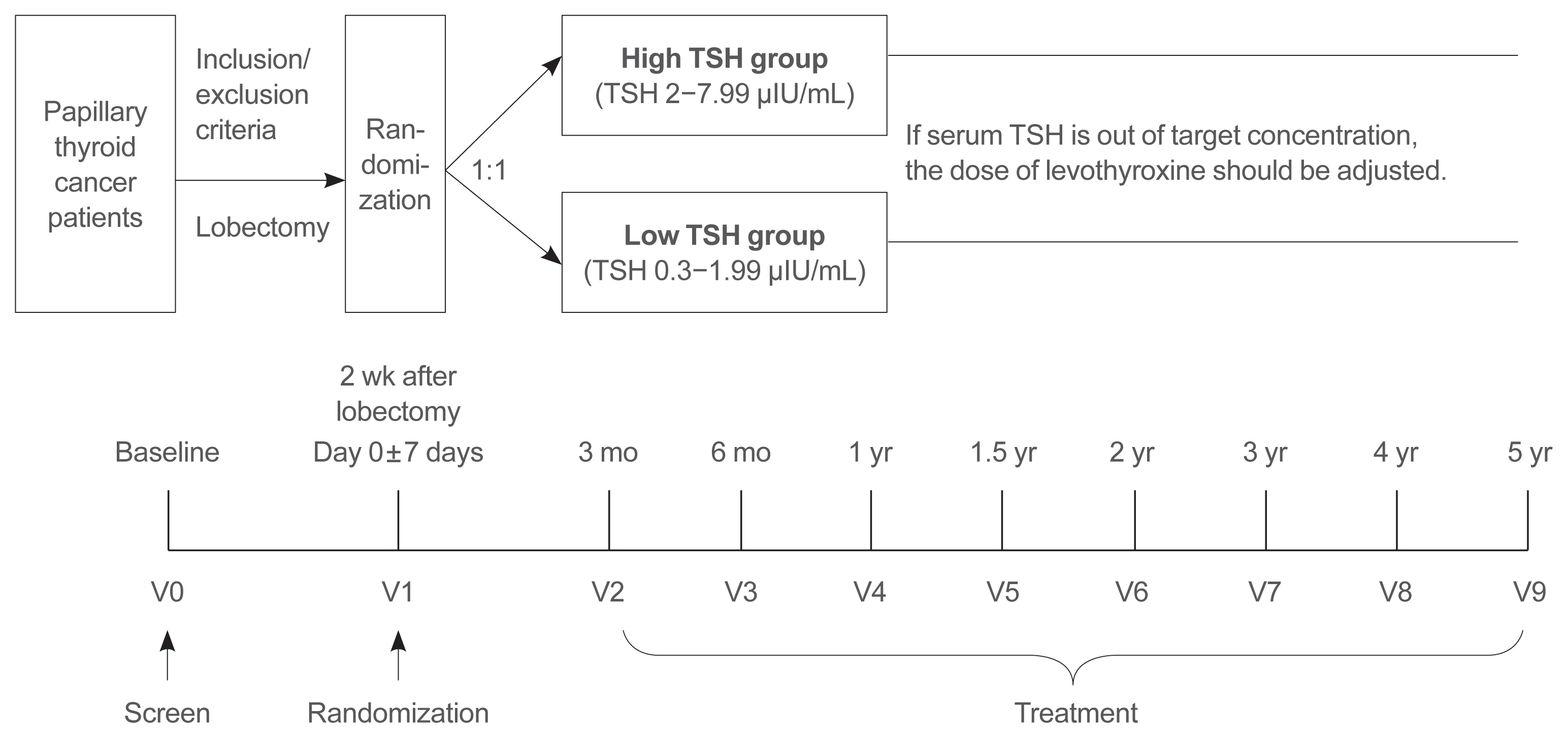
This is a multicenter, prospective, randomized, controlled clinical trial in which 2,986 patients with papillary thyroid cancer are randomized into a high-TSH group (intervention) and a low-TSH group (control) after having undergone a lobectomy. The principle of treatment includes a TSH-lowering regimen aimed at TSH levels between 0.3 and 1.99 μIU/mL in the low-TSH group. The high-TSH group targets TSH levels between 2.0 and 7.99 μIU/mL. The dose of levothyroxine will be adjusted at each visit to maintain the target TSH level. The primary outcome is recurrence-free survival, as assessed by neck ultrasound every 6 to 12 months. Secondary endpoints include disease-free survival, overall survival, success rate in reaching the TSH target range, the proportion of patients with major cardiovascular diseases or bone metabolic disease, the quality of life, and medical costs. The follow-up period is 5 years.
Conclusion
The results of this trial will contribute to establishing the optimal indication for TSH suppression therapy in low-risk papillary thyroid cancer patients by evaluating the benefit and harm of lowering TSH levels in terms of recurrence, metabolic complications, costs, and quality of life. -
Citations
Citations to this article as recorded by- Korean Thyroid Association Guidelines on the Management of Differentiated Thyroid Cancers; Part II. Follow-up Surveillance after Initial Treatment 2026
Eun Kyung Lee, Seung Heon Kang, Bon Seok Koo, Mijin Kim, Min Joo Kim, Bo Hyun Kim, Ji Won Kim, Dong Gyu Na, Sohyun Park, Ji-In Bang, Kyorim Back, Youngduk Seo, Young-Ik Son, Young Shin Song, Dong Yeob Shin, Jong-Hyuk Ahn, Hwa Young Ahn, So Won Oh, Ho-Ryun
International Journal of Thyroidology.2026; 19(1): 1. CrossRef - Incidence and predictors of spontaneous thyroid-stimulating hormone normalization after lobectomy for low-risk papillary thyroid microcarcinoma: evidence from contemporary clinical practice
Zhou Ting Li, Ling Ye, Wu Long Du, Wu Jing Liu, Yan Jie Zhao, Lei Zhu, Jian Song Ji, Feng Cheng
Frontiers in Surgery.2026;[Epub] CrossRef - Patterns of complementary and alternative medicine use and factors influencing its utilization in thyroid cancer: findings from the MASTER study
Han-Sang Baek, Mijin Kim, Kyungsik Kim, Woojin Lim, Kwangsoon Kim, Ja Seong Bae, Dong-Jun Lim, Eun-Jae Chung, Bon Seok Koo, Sung Yong Choi, Eun Kyung Lee, Eu Jeong Ku, Kyeong Jin Kim, Hee Kyung Kim, June Young Choi, Bo Hyun Kim, Sue K. Park
BMC Complementary Medicine and Therapies.2026;[Epub] CrossRef - Korean Thyroid Association Guidelines on the Management of Differentiated Thyroid Cancers, Part II: Follow-up Surveillance after Initial Treatment 2026
Eun Kyung Lee, Seung Heon Kang, Bon Seok Koo, Mijin Kim, Min Joo Kim, Bo Hyun Kim, Ji Won Kim, Dong Gyu Na, Sohyun Park, Ji-In Bang, Kyorim Back, Youngduk Seo, Young-Ik Son, Young Shin Song, Dong Yeob Shin, Jong-hyuk Ahn, Hwa Young Ahn, So Won Oh, Ho-Ryun
Endocrinology and Metabolism.2026; 41(4): 493. CrossRef - Effects of 131I and TSH suppression therapy on METTL3, METTL14 levels and recurrence in thyroid cancer
Li-Guo Yang
American Journal of Cancer Research.2025; 15(1): 42. CrossRef - Levothyroxine supplementation after hemithyroidectomy in patients with low-risk differentiated thyroid cancer: risk factors and withdrawal strategy
Jin Seok Lee, Eun Ju Ha, Ho Jung Jeong, Soo Young Kim, Hyeung Kyoo Kim
Frontiers in Endocrinology.2025;[Epub] CrossRef - Follow-up and transition of care for low recurrence risk thyroid cancer patients in Canada
Ralf Paschke, Sana Ghaznavi, Syed Ali Imran, Jennifer Jacquier, Heather Lochnan, Marie-Hélène Massicotte, Elliot Mitmaker, Deric Morrison, Vicki Munro, Michelle Sveistrup, Sam M Wiseman, Afshan Zahedi
European Thyroid Journal.2025;[Epub] CrossRef - Effect of thyroid-stimulating hormone suppression on quality of life in thyroid lobectomy patients: interim analysis of a multicenter, randomized controlled trial in low- to intermediate-risk thyroid cancer patients (MASTER study)
Ja Kyung Lee, Eu Jeong Ku, Su-jin Kim, Woochul Kim, Jae Won Cho, Kyong Yeun Jung, Hyeong Won Yu, Yea Eun Kang, Mijin Kim, Hee Kyung Kim, Junsun Ryu, June Young Choi
Annals of Surgical Treatment and Research.2024; 106(1): 19. CrossRef - Clinical impact of coexistent chronic lymphocytic thyroiditis on central lymph node metastasis in low- to intermediate-risk papillary thyroid carcinoma: The MASTER study
Da Beom Heo, Ho-Ryun Won, Kyung Tae, Yea Eun Kang, Eonju Jeon, Yong Bae Ji, Jae Won Chang, June Young Choi, Hyeong Won Yu, Eu Jeong Ku, Eun Kyung Lee, Mijin Kim, Jun-Ho Choe, Bon Seok Koo
Surgery.2024; 175(4): 1049. CrossRef - Dynamic Changes in Treatment Response af-ter 131I in Differentiated Thyroid Cancer and Their Relationship with Recurrence Risk Stratification and TNM Staging
璐 狄
Advances in Clinical Medicine.2024; 14(03): 1083. CrossRef - Korean Thyroid Association Guidelines on the Management of Differentiated Thyroid Cancers; Part II. Follow-up Surveillance after Initial Treatment 2024
Mijin Kim, Ji-In Bang, Ho-Cheol Kang, Sun Wook Kim, Dong Gyu Na, Young Joo Park, Youngduk Seo, Young Shin Song, So Won Oh, Sang-Woo Lee, Eun Kyung Lee, Ji Ye Lee, Dong-Jun Lim, Ari Chong, Yun Jae Chung, Chae Moon Hong, Min Kyoung Lee, Bo Hyun Kim
International Journal of Thyroidology.2024; 17(1): 115. CrossRef - Levothyroxine Dosage and the Increased Risk of Second Primary Malignancy in Thyroid Cancer Survivors
Young Joo Park
Clinical Thyroidology®.2024; 36(7): 258. CrossRef - Thyroid-stimulating hormone suppression in low-risk papillary thyroid cancer: a large-scale retrospective analysis of real-world data
Xiao Shi, Haitao Tang, Tingting Zhang, Yunjun Wang, Cenkai Shen, Yan Zhang, Yuxin Du, Wenjun Wei, Zimeng Li, Chuqiao Liu, Xiaoqi Mao, Shaoyan Liu, Qinghai Ji, Jie Liu, Yu Wang
eClinicalMedicine.2024; 77: 102912. CrossRef - Prognostic Implications of Maintaining the Target Thyroid-Stimulating Hormone Status Based on the 2015 American Thyroid Association Guidelines in Patients with Low-Risk Papillary Thyroid Carcinoma after Lobectomy: A 5-Year Landmark Analysis
Ye Won Jeon, Young Jin Suh, Seung Taek Lim
Cancers.2024; 16(19): 3253. CrossRef - Associations of gestational thyrotropin levels with disease progression among pregnant women with differentiated thyroid cancer: a retrospective cohort study
Xin Li, Peng Fu, Wu-Cai Xiao, Fang Mei, Fan Zhang, Shanghang Zhang, Jing Chen, Rui Shan, Bang-Kai Sun, Shi-Bing Song, Chun-Hui Yuan, Zheng Liu
Frontiers in Endocrinology.2024;[Epub] CrossRef - ASO Author Reflections: Active Surveillance may be Possible in Patients with T1b Papillary Thyroid Carcinoma Over 55 Years of Age Without High-Risk Features on Preoperative Examinations
Ho-Ryun Won, Eonju Jeon, Da Beom Heo, Jae Won Chang, Minho Shong, Je Ryong Kim, Hyemi Ko, Yea Eun Kang, Hyon-Seung Yi, Ju Hee Lee, Kyong Hye Joung, Ji Min Kim, Younju Lee, Sung-Woo Kim, Young Ju Jeong, Yong Bae Ji, Kyung Tae, Bon Seok Koo
Annals of Surgical Oncology.2023; 30(4): 2254. CrossRef - Outcomes and Trends of Treatments in High‐Risk Differentiated Thyroid Cancer
Arash Abiri, Khodayar Goshtasbi, Sina J. Torabi, Edward C. Kuan, William B. Armstrong, Tjoson Tjoa, Yarah M. Haidar
Otolaryngology–Head and Neck Surgery.2023; 168(4): 745. CrossRef - Current Controversies in Low-Risk Differentiated Thyroid Cancer: Reducing Overtreatment in an Era of Overdiagnosis
Timothy M Ullmann, Maria Papaleontiou, Julie Ann Sosa
The Journal of Clinical Endocrinology & Metabolism.2023; 108(2): 271. CrossRef - Age-Dependent Clinicopathological Characteristics of Patients with T1b Papillary Thyroid Carcinoma: Implications for the Possibility of Active Surveillance
Ho-Ryun Won, Eonju Jeon, Da Beom Heo, Jae Won Chang, Minho Shong, Je Ryong Kim, Hyemi Ko, Yea Eun Kang, Hyon-Seung Yi, Ju Hee Lee, Kyong Hye Joung, Ji Min Kim, Younju Lee, Sung-Woo Kim, Young Ju Jeong, Yong Bae Ji, Kyung Tae, Bon Seok Koo
Annals of Surgical Oncology.2023; 30(4): 2246. CrossRef - Potential impact of obesity on the aggressiveness of low- to intermediate-risk papillary thyroid carcinoma: results from a MASTER cohort study
Mijin Kim, Yae Eun Kang, Young Joo Park, Bon Seok Koo, Eu Jeong Ku, June Young Choi, Eun Kyung Lee, Bo Hyun Kim
Endocrine.2023; 82(1): 134. CrossRef - Differentiated thyroid cancer: a focus on post-operative thyroid hormone replacement and thyrotropin suppression therapy
Benjamin J. Gigliotti, Sina Jasim
Endocrine.2023; 83(2): 251. CrossRef - Thyroid stimulating hormone suppression and recurrence after thyroid lobectomy for papillary thyroid carcinoma
Mi Rye Bae, Sung Hoon Nam, Jong-Lyel Roh, Seung-Ho Choi, Soon Yuhl Nam, Sang Yoon Kim
Endocrine.2022; 75(2): 487. CrossRef - The Concept of Economic Evaluation and Its Application in Thyroid Cancer Research
Kyungsik Kim, Mijin Kim, Woojin Lim, Bo Hyun Kim, Sue K. Park
Endocrinology and Metabolism.2021; 36(4): 725. CrossRef
- Korean Thyroid Association Guidelines on the Management of Differentiated Thyroid Cancers; Part II. Follow-up Surveillance after Initial Treatment 2026
 First
 Prev




